
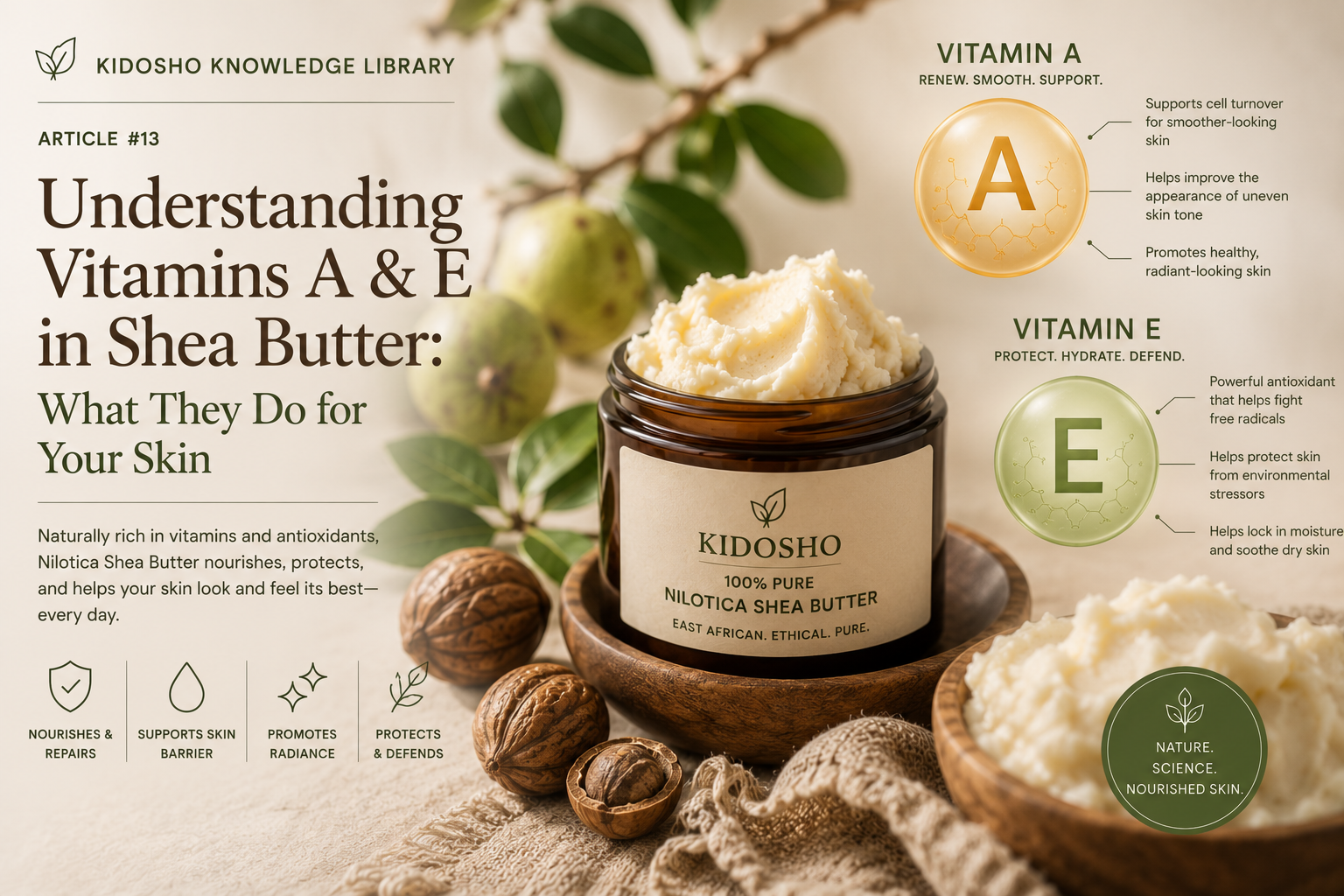
Understanding Vitamins A & E in Shea Butter: What They Do for Your Skin

Nature’s Ingredients, Working Together
When people talk about Shea Butter, they often mention that it contains Vitamins A and E.
But what does that actually mean?
Are these vitamins added during manufacturing?
Do they transform your skin?
Or are they simply part of what makes Shea Butter such a remarkable natural ingredient?
The answer is more nuanced than many marketing claims suggest.
Pure Nilotica Shea Butter naturally contains a complex mixture of fatty acids and plant compounds, including naturally occurring tocopherols (Vitamin E) and compounds associated with Vitamin A activity, along with phytosterols and triterpenes.
Together, these naturally occurring components help explain why Shea Butter has been valued in skincare for generations.
In This Article
You’ll learn:
- What Vitamins A and E are
- Which vitamins naturally occur in Shea Butter
- How they support healthy skin
- Why antioxidants matter
- Common myths about Shea Butter vitamins
- What scientific research says
Shea Butter Is Naturally Complex
As we’ve explored throughout the KIDOSHO Knowledge Library, Shea Butter is much more than a simple fat.
It naturally contains:
- triglycerides
- oleic acid
- stearic acid
- linoleic acid
- palmitic acid
- phytosterols
- triterpenes
- tocopherols (Vitamin E)
- other naturally occurring bioactive compounds
These components work together to create the rich, nourishing character of pure Nilotica Shea Butter.
Understanding Vitamin E
Vitamin E is the nutrient most consistently identified in scientific analyses of Shea Butter.
In cosmetic science, Vitamin E primarily exists as a family of compounds known as tocopherols.
These naturally occurring antioxidants help protect plant oils from oxidation and contribute to Shea Butter’s skin-conditioning properties.¹
When applied to the skin, Vitamin E is valued because it helps:
- support the skin’s natural barrier
- condition the skin
- help protect against oxidative stress caused by environmental exposure
- contribute to smoother-feeling skin
It’s important to note that skincare products containing Vitamin E are intended to support healthy skin—not to treat or prevent disease.
What About Vitamin A?
Vitamin A is often mentioned in discussions of Shea Butter, but the science deserves careful explanation.
Unlike Vitamin E, scientific studies do not consistently identify high levels of preformed Vitamin A (retinol) in Shea Butter.
Instead, Shea Butter contains naturally occurring plant compounds—including certain triterpenes and carotenoid-related compounds—that are sometimes associated with Vitamin A activity or are discussed in relation to skin health.²
This distinction matters.
Rather than claiming Shea Butter is rich in retinol, it’s more accurate to say that its naturally occurring plant compounds contribute to its overall value as a cosmetic moisturizer.
Why Antioxidants Matter
Every day, our skin is exposed to environmental stressors such as:
- sunlight
- air pollution
- cigarette smoke
- changing weather
- normal metabolic processes
These factors contribute to the formation of free radicals, unstable molecules that can contribute to oxidative stress.
Antioxidants help neutralize free radicals before they can cause further oxidative damage.
While no skincare ingredient can completely prevent environmental stress, antioxidant-rich ingredients like Shea Butter contribute to a well-rounded skincare routine.
Vitamins Work Best as Part of the Whole Ingredient
One of the reasons KIDOSHO uses 100% pure Nilotica Shea Butter is that nature has already created a remarkably balanced ingredient.
Rather than isolating individual vitamins or adding synthetic ingredients, Shea Butter naturally delivers:
- moisturizing fatty acids
- antioxidant compounds
- plant sterols
- skin-conditioning lipids
These components work together as part of the butter’s natural composition.
This is one reason many skincare scientists view whole botanical ingredients differently from isolated nutrients.
More Isn’t Always Better
Modern skincare often emphasizes high concentrations of individual ingredients.
Higher percentages.
Stronger formulas.
More active compounds.
While active ingredients have an important place in dermatology, everyday moisturizing often benefits from ingredients that support the skin gently and consistently.
Pure Shea Butter isn’t designed to replace prescription retinoids or dermatologist-directed treatments.
Instead, it provides a naturally balanced combination of lipids and plant compounds that help maintain healthy-looking skin.
The Importance of Minimal Processing
The way Shea Butter is processed can influence the amount of naturally occurring compounds it retains.
Excessive refining, bleaching, or deodorizing may reduce the concentration of certain bioactive components.
At KIDOSHO, we carefully source 100% pure Nilotica Shea Butter with minimal processing to preserve its natural composition as much as possible while ensuring quality and safety.
Science Over Marketing
You’ll sometimes see Shea Butter advertised with claims such as:
- “Loaded with Vitamin A.”
- “Pure Vitamin E moisturizer.”
- “Repairs skin overnight.”
These statements often oversimplify the science.
The evidence supports a more balanced understanding:
- Shea Butter naturally contains tocopherols (Vitamin E).
- It contains plant compounds associated with skin-conditioning properties.
- Its greatest strength comes from the combination of its fatty acids and naturally occurring bioactive compounds—not from one vitamin alone.
At KIDOSHO, we believe informed consumers deserve accurate information, even when it’s less dramatic than marketing headlines.
What the Research Says
Scientific reviews consistently identify tocopherols (Vitamin E) as naturally occurring components of Shea Butter. Tocopherols contribute antioxidant activity and help support the stability of plant oils while providing skin-conditioning benefits in cosmetic formulations.¹
Research also shows that Shea Butter contains a significant unsaponifiable fraction, including phytosterols, triterpenes, and other naturally occurring plant compounds that contribute to its unique cosmetic properties.²
Although Shea Butter is frequently described in popular media as containing Vitamins A and E, the evidence is stronger for naturally occurring Vitamin E than for significant amounts of preformed Vitamin A (retinol). Current scientific literature suggests that the skin benefits of Shea Butter arise from the interaction of its fatty acids, antioxidant compounds, and unsaponifiable components rather than from any single vitamin alone.³
Frequently Asked Questions
Does Shea Butter naturally contain Vitamin E?
Yes.
Scientific studies consistently identify naturally occurring tocopherols, which are forms of Vitamin E, in Shea Butter.
Does Shea Butter contain Vitamin A?
Shea Butter is commonly associated with Vitamin A in skincare marketing, but scientific evidence does not consistently show significant levels of preformed Vitamin A (retinol). Its skin benefits are better explained by its overall composition of fatty acids and plant compounds.
What do antioxidants do for the skin?
Antioxidants help protect the skin from oxidative stress caused by environmental factors such as UV exposure and pollution. They are one part of a comprehensive skincare routine.
Are Vitamins A and E added to KIDOSHO Shea Butter?
No.
KIDOSHO contains 100% pure Nilotica Shea Butter with no added vitamins or synthetic ingredients. The compounds present occur naturally within the butter.
Is Shea Butter a replacement for retinol?
No.
Retinol is a well-studied cosmetic ingredient with specific effects on skin renewal. Shea Butter serves a different role as a moisturizer and skin-conditioning ingredient.
Key Takeaways
- Pure Nilotica Shea Butter naturally contains tocopherols (Vitamin E) and a variety of beneficial plant compounds.
- Scientific evidence is stronger for Vitamin E than for significant amounts of preformed Vitamin A.
- Shea Butter’s moisturizing benefits come from the combined action of fatty acids, antioxidants, phytosterols, and triterpenes.
- Minimal processing helps preserve many of these naturally occurring components.
- KIDOSHO believes accurate science is the foundation of informed skincare.
Related Articles
Previously in the KIDOSHO Knowledge Library
← Article #1: What Is Nilotica Shea Butter?
← Article #6: How Shea Butter Moisturizes Skin
← Article #10: Daily Shea Butter Routine
← Article #11: West African vs. East African Shea Butter
← Article #12: How Nilotica Shea Is Harvested
Continue Reading
→ Article #14: Pure Shea Butter: One Ingredient, Many Benefits
You may also enjoy:
- Benefits of Shea Butter for Dry Skin (Article #4)
- Sensitive Skin Guide (Article #5)
- The Nilotica Shea Tree (Article #7)
- From Tree to Jar (Article #3)
References
- Zhang, X., et al. (2026). Shea Butter: A Comprehensive Review of Its Compositions, Processing, Applications, and Challenges. Journal of the American Oil Chemists’ Society.
- Maranz, S., & Wiesman, Z. (2003). Studies on the chemical composition and unsaponifiable fraction of Vitellaria paradoxa.
- ScienceDirect Topics. Shea Butter (Vitellaria paradoxa): Composition, Properties and Applications.
- Lin, T.-K., Zhong, L., & Santiago, J. L. (2018). Anti-Inflammatory and Skin Barrier Repair Effects of Topical Application of Some Plant Oils. International Journal of Molecular Sciences. This review discusses how naturally occurring plant lipids and antioxidants support skin barrier function.
About KIDOSHO
At KIDOSHO, we believe that trust begins with transparency.
Our 100% pure, ethically sourced Nilotica Shea Butter contains no added vitamins, fragrances, or fillers—only the naturally occurring compounds that make Shea Butter one of nature’s most respected skincare ingredients.
Through the KIDOSHO Knowledge Library, we separate scientific evidence from marketing myths, helping you understand not just what is in your skincare, but why it matters.
Natural is the New Beautiful.