
How Nilotica Shea Is Harvested: A Tradition Guided by Nature

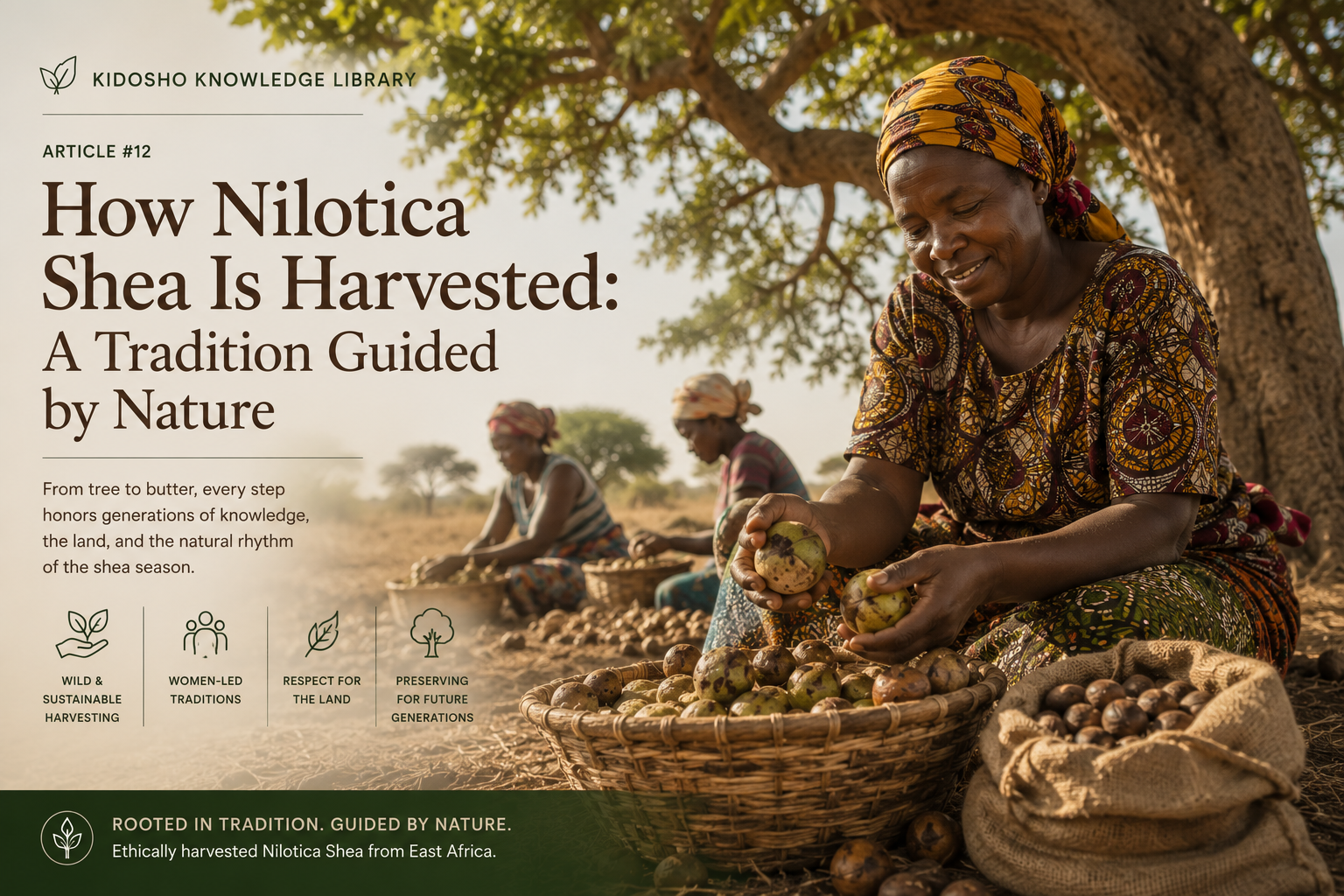
Nature Sets the Schedule
In modern agriculture, many crops are planted, irrigated, and harvested according to carefully controlled schedules.
The Nilotica Shea tree follows a different rhythm.
It flowers when nature allows.
It bears fruit once each year.
And when the fruit is ready, it falls naturally to the ground—signaling that the harvest can begin.
There are no shortcuts.
No accelerated growing seasons.
No industrial plantations stretching across thousands of acres.
Only wild trees, seasonal harvests, and generations of knowledge that guide every step.
At KIDOSHO, we believe the harvest is where the story of exceptional Shea Butter truly begins.
In This Article
You’ll learn:
- When Nilotica Shea is harvested
- Why the fruit is collected from the ground
- How harvesting protects the trees
- What happens after the fruit is collected
- Why traditional harvesting remains important
- How sustainable harvesting supports future generations
A Harvest That Happens Only Once a Year
Unlike many crops that produce multiple harvests each year, the Nilotica Shea tree follows a single annual cycle.
Following the rainy season, mature trees develop clusters of green fruit that gradually ripen over several weeks.
When the fruit reaches full maturity, it naturally detaches from the tree and falls to the ground.
Only then does harvesting begin.
This natural process ensures that the kernel inside each fruit has had the opportunity to develop fully before collection.
Why the Fruit Isn’t Picked from the Tree
One of the defining features of traditional Shea harvesting is patience.
Rather than removing fruit directly from branches, harvesters wait for nature to complete the process.
Collecting naturally fallen fruit offers several advantages:
- allows the fruit to mature fully
- avoids damaging branches
- protects future harvests
- respects the tree’s natural reproductive cycle
- minimizes unnecessary stress on the tree
This practice has been followed across Shea-producing regions for generations and remains an important part of sustainable harvesting.
Harvesting by Hand
Unlike highly mechanized crops, Nilotica Shea harvesting remains largely manual.
Harvesters walk beneath mature trees, gathering freshly fallen fruit into baskets or containers.
Care is taken to:
- collect clean fruit
- avoid damaged or spoiled fruit
- separate debris
- transport the harvest promptly for processing
Because the trees are often spread across natural landscapes rather than planted in orchards, harvesting requires both time and local knowledge.
Inside Every Fruit
At first glance, the Shea fruit resembles a small green plum.
The outer pulp is soft and edible.
Inside is a single hard nut.
Within that nut lies the Shea kernel—the part of the fruit that contains the rich natural oils used to produce Shea Butter.
As we explored in Article #3: From Tree to Jar, protecting the quality of the kernel begins the moment the fruit is harvested.
What Happens After Harvest?
Harvesting is only the first step.
Soon after collection, the fruit begins moving through a carefully managed process.
The typical sequence includes:
1. Removing the Fruit Pulp
The edible pulp is separated from the nut.
2. Washing
The nuts are cleaned to remove dirt and plant material.
3. Drying
The nuts are dried to reduce moisture and prepare them for storage.
Proper drying helps maintain kernel quality before processing.
4. Storage
The dried nuts are stored under appropriate conditions until they are ready for cracking and butter production.
Each step influences the quality of the finished Shea Butter.
Harvesting with the Future in Mind
The Shea tree represents a long-term natural resource.
Because a tree may require two decades before producing meaningful harvests, protecting mature trees is essential.
Responsible harvesting means:
- collecting only naturally fallen fruit
- avoiding damage to branches
- protecting young trees
- preserving surrounding ecosystems
- encouraging natural regeneration
Sustainability is not simply about today’s harvest.
It’s about ensuring there will be harvests for future generations.
A Partnership Between People and Nature
Harvesting Shea is not an industrial process.
It is a partnership.
Nature determines when fruit is ready.
Communities determine how carefully it is collected.
This balance has allowed Shea trees and local communities to coexist for centuries.
Rather than forcing higher production, traditional harvesting works within the natural rhythms of the ecosystem.
Why Harvest Timing Matters
Timing has a direct impact on quality.
Fruit collected too early may contain immature kernels.
Fruit left on the ground too long may deteriorate because of insects, excessive moisture, or microbial activity.
Experienced harvesters understand these seasonal patterns through years of observation.
Their knowledge helps ensure that high-quality kernels move forward into the processing stage.
Why KIDOSHO Values Traditional Harvesting
At KIDOSHO, we believe exceptional ingredients begin with exceptional care.
The quality of pure Nilotica Shea Butter is influenced long before processing begins.
It starts with:
- healthy wild trees
- responsible harvesting
- careful handling
- respect for traditional knowledge
- commitment to sustainability
Every jar reflects these values.
What the Research Says
Research on the Shea value chain emphasizes that most Shea Butter continues to originate from wild-growing trees rather than commercial plantations. Harvesting traditionally begins only after mature fruit naturally falls to the ground, helping protect both the tree and the developing kernels.¹
Scientific and development organizations also recognize that careful harvesting practices contribute to maintaining kernel quality while supporting long-term sustainability of Shea parklands.²
Studies further highlight that sustainable harvesting depends upon preserving mature trees, encouraging natural regeneration, and maintaining the ecological health of the landscapes where Shea grows naturally.³
Frequently Asked Questions
When is Nilotica Shea harvested?
Harvest seasons vary slightly by region and weather conditions, but Nilotica Shea is generally harvested once each year after the fruit ripens and naturally falls from the tree.
Why isn’t the fruit picked directly from the tree?
Traditional harvesting waits until the fruit falls naturally, allowing the kernels to mature fully while minimizing damage to the tree.
Is Shea harvested by machines?
No.
Most Shea harvesting remains a manual process carried out by local communities using traditional methods.
Does harvesting harm the tree?
When performed responsibly, traditional harvesting does not harm the tree because only naturally fallen fruit is collected.
Why are wild Shea trees important?
Wild Shea trees support biodiversity, protect soils, provide seasonal income for communities, and produce the kernels used to make authentic Shea Butter.
Key Takeaways
- Nilotica Shea is harvested only once each year.
- Harvest begins after ripe fruit naturally falls from the tree.
- Traditional harvesting protects both the trees and future harvests.
- Careful handling during collection helps preserve kernel quality.
- Sustainable harvesting reflects a partnership between nature and local communities.
- Every jar of KIDOSHO begins with respect for this centuries-old tradition.
Related Articles
Previously in the KIDOSHO Knowledge Library
← Article #3: From Tree to Jar: The Journey of Pure Nilotica Shea Butter
← Article #7: The Nilotica Shea Tree
← Article #8: The Communities Behind KIDOSHO
← Article #9: Supporting Women Through Ethical Sourcing
← Article #11: West African vs. East African Shea Butter
Continue Reading
→ Article #13: Pure Shea Butter: One Ingredient, Many Benefits
You may also enjoy:
- What Is Nilotica Shea Butter? (Article #1)
- Benefits of Shea Butter for Dry Skin (Article #4)
- How Shea Butter Moisturizes Skin (Article #6)
- Daily Shea Butter Routine (Article #10)
References
- Hall, J. B., Aebischer, D. P., Tomlinson, H. F., Osei-Amaning, E., & Hindle, J. R. (1996). Vitellaria paradoxa: A Monograph. University of Wales, Bangor. A foundational reference on Shea tree biology, distribution, and harvesting practices.
- Food and Agriculture Organization (FAO). Publications on the Shea value chain, sustainable harvesting, post-harvest handling, and community livelihoods.
- World Agroforestry (ICRAF). Research on Shea parkland ecosystems, biodiversity conservation, and sustainable management of wild Shea resources.
- Lovett, P. N. (2004). The Shea Butter Value Chain: Production, Transformation and Marketing in West and East Africa. A widely cited overview of harvesting, processing, quality, and market systems for Shea.
About KIDOSHO
Every jar of KIDOSHO begins with a harvest guided by patience rather than speed.
Our 100% pure, ethically sourced Nilotica Shea Butter comes from wild-growing Shea trees that are harvested using time-honored practices designed to respect both nature and the communities who care for it. We believe the finest skincare ingredients are those that honor the entire journey—from tree to harvest, from harvest to jar.
Through the KIDOSHO Knowledge Library, we invite you to discover not only what makes Nilotica Shea Butter exceptional, but also the traditions and people that make it possible.
Natural is the New Beautiful.