
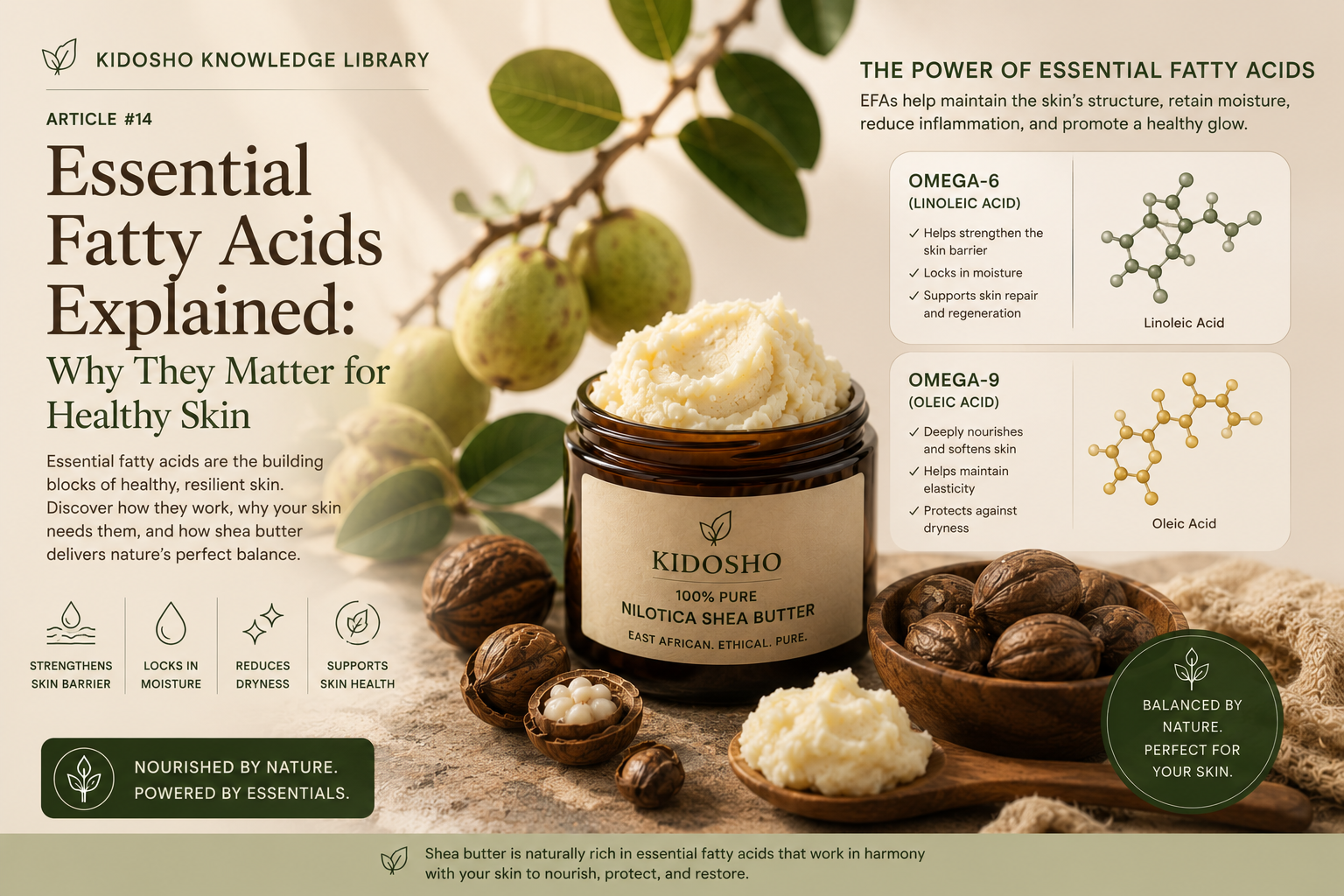
Essential Fatty Acids Explained: Why They Matter for Healthy Skin

The Real Secret Behind Shea Butter
When people describe Shea Butter, they often say it is rich, nourishing, or deeply moisturizing.
But what gives it those qualities?
The answer isn’t found in a single vitamin or miracle ingredient.
It’s found in a remarkable blend of naturally occurring fatty acids.
These lipids are responsible for Shea Butter’s texture, how it melts on the skin, and how it helps support the skin’s natural moisture barrier.
At KIDOSHO, we believe understanding these natural building blocks helps explain why 100% pure Nilotica Shea Butter has earned its reputation as one of nature’s most trusted moisturizers.
In This Article
You’ll learn:
- What fatty acids are
- Which fatty acids are found in Shea Butter
- Why they matter for skin health
- The difference between essential and non-essential fatty acids
- Why Nilotica Shea Butter feels different
- What scientific research says
What Are Fatty Acids?
Fatty acids are natural components of fats and oils.
They occur throughout nature—in plants, animals, and even within our own skin.
Your skin’s outer layer contains lipids that help:
- retain moisture
- maintain flexibility
- strengthen the skin barrier
- protect against environmental stress
As we explored in Article #6: How Shea Butter Moisturizes Skin, healthy skin depends on maintaining this protective barrier.
The fatty acids in Shea Butter help support that natural function.
Essential vs. Non-Essential Fatty Acids
The term essential fatty acids has a specific scientific meaning.
Essential fatty acids are those the human body cannot produce in sufficient amounts and must obtain through diet. The two primary essential fatty acids are:
- Linoleic acid (Omega-6)
- Alpha-linolenic acid (Omega-3)
Shea Butter naturally contains linoleic acid, one of these essential fatty acids.
It also contains several other beneficial fatty acids—including oleic, stearic, and palmitic acids—that are not classified as “essential” in nutrition but play important roles in the structure and performance of Shea Butter as a cosmetic ingredient.
For simplicity, many skincare articles refer broadly to Shea Butter’s “fatty acids,” which is the more scientifically accurate description.
The Four Major Fatty Acids in Shea Butter
Although the exact composition varies with geography and harvest conditions, Nilotica Shea Butter is primarily composed of four fatty acids.
Oleic Acid
Oleic acid is the most abundant fatty acid in Nilotica Shea Butter.
It contributes to:
- smooth application
- soft texture
- excellent spreadability
- comfortable skin feel
Nilotica Shea Butter typically contains more oleic acid than West African Shea Butter, which helps explain its naturally creamy consistency.
Stearic Acid
Stearic acid gives Shea Butter structure.
It contributes to:
- richness
- stability
- protective skin feel
- long-lasting moisturization
West African Shea Butter generally contains higher levels of stearic acid, making it firmer at room temperature.
Linoleic Acid
Linoleic acid is an essential fatty acid.
Although present in smaller amounts than oleic or stearic acid, it contributes to:
- supporting the skin barrier
- maintaining skin flexibility
- healthy-looking skin
Healthy skin naturally contains linoleic acid within its lipid barrier.
Palmitic Acid
Palmitic acid contributes to:
- texture
- consistency
- moisturizing performance
- overall stability
Like the other fatty acids, it works as part of the complete natural composition rather than acting independently.
Why Fatty Acids Matter
Think of your skin barrier as a carefully built wall.
The skin cells form the bricks.
Lipids—including fatty acids—help create the mortar between those bricks.
When that mortar becomes depleted, moisture escapes more easily.
Skin becomes:
- dry
- rough
- tight
- uncomfortable
Applying lipid-rich ingredients like Shea Butter helps condition the skin’s surface and supports the barrier that naturally slows moisture loss.
Why Nilotica Shea Butter Feels So Different
Earlier in Article #11: West African vs. East African Shea Butter, we explored how Nilotica Shea Butter naturally contains a higher proportion of oleic acid.
That difference influences:
- texture
- melting point
- spreadability
- absorption
- overall sensory experience
The result is a butter that many people describe as:
- silky
- creamy
- lightweight
- elegant
- easy to massage into the skin
Rather than feeling heavy or waxy, Nilotica Shea Butter melts readily at body temperature.
Fatty Acids Work Together
No single fatty acid explains Shea Butter’s effectiveness.
Its unique performance comes from the balance of its naturally occurring lipids.
Together they help create a moisturizer that:
- softens rough skin
- supports the moisture barrier
- improves skin comfort
- reduces transepidermal water loss (TEWL)
Nature has already optimized this combination over thousands of years.
Whole Ingredients Matter
Modern skincare often isolates individual ingredients.
One product focuses on one acid.
Another highlights one vitamin.
Another promotes one antioxidant.
Pure Shea Butter works differently.
It delivers its fatty acids together in the proportions created by nature.
Combined with tocopherols (Vitamin E), phytosterols, and triterpenes, these lipids create a balanced botanical ingredient that has been valued for centuries.
At KIDOSHO, we believe this natural balance is worth preserving.
More Than Moisture
The fatty acids in Shea Butter don’t simply help skin feel softer.
They also influence:
- texture
- glide
- absorption
- spreadability
- product stability
- user experience
This is one reason formulators around the world continue to incorporate Shea Butter into moisturizers, balms, cleansers, and body care products.
What the Research Says
Scientific studies consistently identify oleic, stearic, linoleic, and palmitic acids as the principal fatty acids in Shea Butter. Their relative proportions vary according to genetics, geography, climate, and processing methods.¹
Research shows that Nilotica Shea Butter generally contains a higher proportion of oleic acid and a lower proportion of stearic acid than West African Shea Butter. This composition contributes to its softer consistency and elegant skin feel.²
Dermatology research also recognizes the importance of lipids in maintaining the skin barrier. By helping reduce transepidermal water loss (TEWL), lipid-rich moisturizers such as Shea Butter support skin hydration and comfort.³
It is important to note that while linoleic acid is an essential fatty acid, Shea Butter is best understood as a source of naturally occurring fatty acids that support skin conditioning, rather than as a nutritional source of essential fats.
Frequently Asked Questions
What are fatty acids?
Fatty acids are natural building blocks of fats and oils. In skincare, they help condition the skin and support the skin’s natural moisture barrier.
Which fatty acid is most abundant in Nilotica Shea Butter?
Oleic acid is typically the most abundant fatty acid in Nilotica Shea Butter.
Does Shea Butter contain essential fatty acids?
Yes.
Shea Butter naturally contains linoleic acid, which is classified as an essential omega-6 fatty acid. It also contains several other naturally occurring fatty acids that contribute to its moisturizing properties.
Why is Nilotica Shea Butter softer?
Its naturally higher oleic acid content gives it a lower melting point and creamier texture than many West African Shea Butters.
Are fatty acids the same as oils?
Not exactly.
Fatty acids are the individual components that make up many natural fats and oils, including Shea Butter.
Key Takeaways
- Shea Butter’s moisturizing properties come largely from its naturally occurring fatty acids.
- Nilotica Shea Butter is especially rich in oleic acid, contributing to its soft, creamy texture.
- Linoleic acid is the primary essential fatty acid found in Shea Butter.
- Together, oleic, stearic, linoleic, and palmitic acids help support the skin’s moisture barrier.
- KIDOSHO preserves the natural balance of these fatty acids by using 100% pure Nilotica Shea Butter with minimal processing.
Related Articles
Previously in the KIDOSHO Knowledge Library
← Article #6: How Shea Butter Moisturizes Skin
← Article #11: West African vs. East African Shea Butter
← Article #12: How Nilotica Shea Is Harvested
← Article #13: Understanding Vitamins A & E in Shea Butter
Continue Reading
→ Article #15: Pure Shea Butter: One Ingredient, Many Benefits
You may also enjoy:
- Benefits of Shea Butter for Dry Skin (Article #4)
- Sensitive Skin Guide (Article #5)
- Daily Shea Butter Routine (Article #10)
- What Is Nilotica Shea Butter? (Article #1)
References
- Zhang, X., et al. (2026). Shea Butter: A Comprehensive Review of Its Compositions, Processing, Applications, and Challenges. Journal of the American Oil Chemists’ Society.
- Maranz, S., Wiesman, Z., Bisgaard, J., & Bianchi, G. (2004). Germplasm Resources of Vitellaria paradoxa Based on Variations in Fat Composition Across the Species Distribution Range. Agroforestry Systems.
- Elias, P. M. (2005). Stratum Corneum Defensive Functions: An Integrated View. Journal of Investigative Dermatology.
- Lin, T.-K., Zhong, L., & Santiago, J. L. (2018). Anti-Inflammatory and Skin Barrier Repair Effects of Topical Application of Some Plant Oils. International Journal of Molecular Sciences.
About KIDOSHO
At KIDOSHO, we believe that the best skincare ingredients don’t need to be reinvented—they need to be understood.
Every jar of our 100% pure, ethically sourced Nilotica Shea Butter contains the naturally balanced fatty acids, antioxidants, and plant compounds that have supported healthy skin for generations. We preserve this natural composition through careful sourcing and minimal processing, allowing nature’s own formulation to shine.
Through the KIDOSHO Knowledge Library, our goal is to replace marketing myths with clear, evidence-based education—so you can care for your skin with confidence.
Natural is the New Beautiful.