
Supporting Women Through Ethical Sourcing: Why Every Jar Can Make a Difference

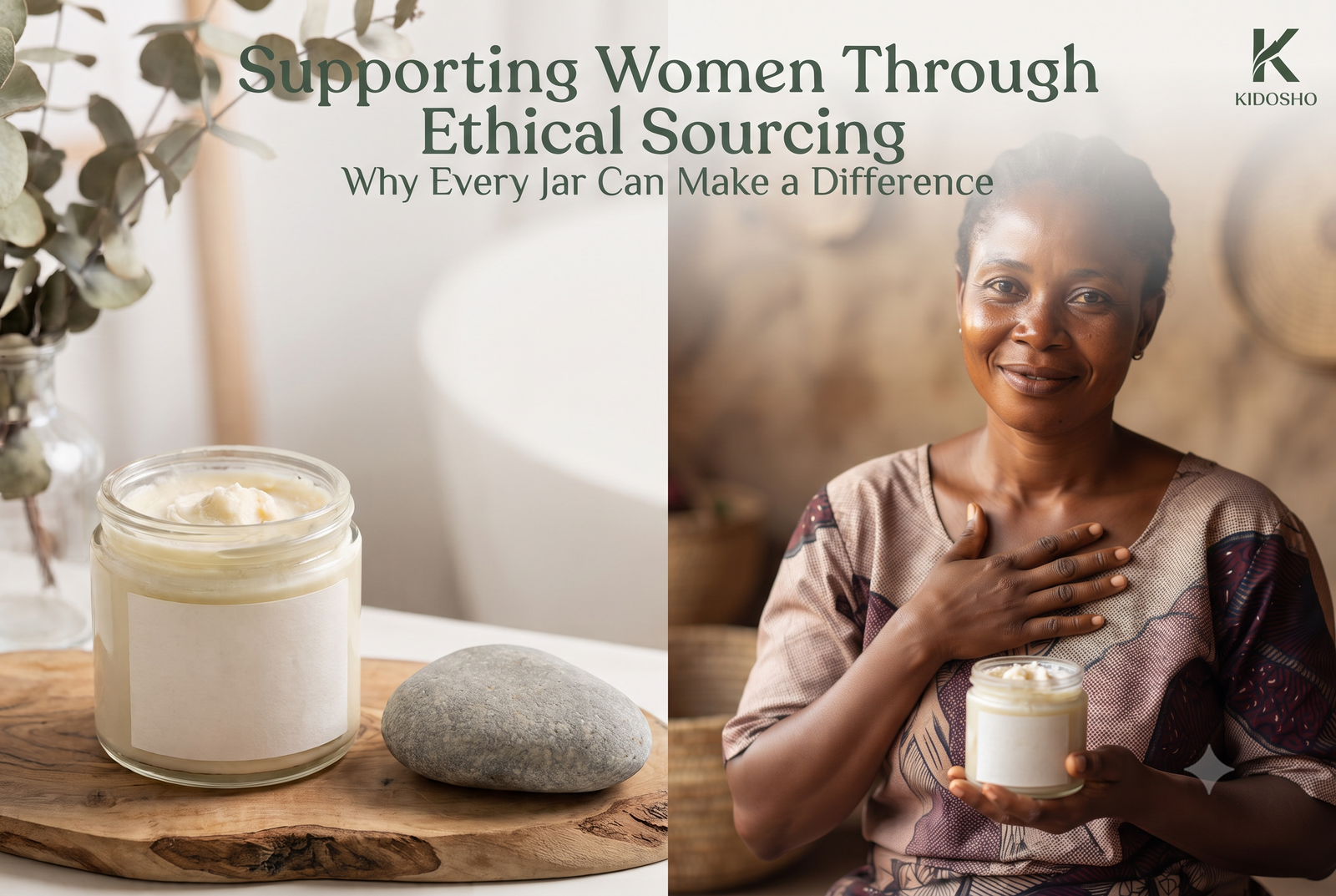
When You Choose Better, You Help Build Better
Every skincare purchase is also a business decision.
It supports a supply chain.
It rewards certain practices.
And it helps shape the future of the communities that produce the ingredients we use every day.
For generations across Africa, women have played a central role in the journey from Shea fruit to Shea Butter. Their knowledge, skill, and dedication have preserved a tradition that continues to nourish millions of people around the world.
At KIDOSHO, ethical sourcing means recognizing that extraordinary skincare begins with extraordinary people.
In This Article
You’ll learn:
- Why women are central to the Shea value chain
- How Shea production supports families and communities
- What ethical sourcing really means
- Why long-term partnerships matter
- How consumers can encourage responsible business
- KIDOSHO’s sourcing philosophy
The Human Story Behind Shea Butter
When people think about Shea Butter, they often picture the finished product.
Far fewer think about the people who make it possible.
As we explored in Article #8: The Communities Behind KIDOSHO, Shea Butter production begins long before the butter reaches a processing facility.
It begins with families.
Communities.
Traditional knowledge.
And, in many regions, women whose expertise has shaped the Shea industry for generations.
Women Have Long Been the Keepers of Shea Knowledge
Across many Shea-producing regions of Africa, women have traditionally led much of the work involved in producing Shea Butter.
Their responsibilities often include:
- gathering naturally fallen fruit
- removing the pulp
- drying the nuts
- cracking the shells
- processing the kernels
- producing Shea Butter
- maintaining quality
- selling Shea products within local markets
These skills are often learned over many years through observation and experience.
Knowledge is passed from one generation to the next, helping preserve both cultural traditions and product quality.
Why Shea Matters to Families
For many households, Shea is more than a seasonal harvest.
It is part of a diversified livelihood.
Income generated through Shea production may help families pay for:
- school fees
- healthcare
- nutritious food
- clothing
- household improvements
- small business investments
The exact role varies from community to community, but the broader pattern is consistent: Shea contributes to household resilience and economic opportunity.
Ethical Sourcing Is About Relationships
Ethical sourcing is sometimes misunderstood as simply paying a fair price.
While fair compensation is important, responsible sourcing goes much further.
It also includes:
- transparency
- mutual respect
- safe working conditions
- long-term partnerships
- consistent quality standards
- environmental stewardship
- shared growth
Strong supply chains are built on trust—not transactions alone.
Investing in Skills, Not Just Products
The quality of exceptional Shea Butter reflects years of experience.
Harvest timing.
Kernel preparation.
Drying.
Storage.
Traditional processing techniques.
These are skilled practices that deserve recognition.
Supporting ethical sourcing means recognizing the value of this expertise rather than viewing Shea solely as a commodity.
Sustainability Begins with Opportunity
Environmental conservation and economic opportunity often reinforce one another.
When communities benefit from healthy Shea trees, they have greater incentives to protect them.
This creates a cycle where:
healthy trees →
healthy harvests →
stronger incomes →
continued conservation →
future harvests
Protecting ecosystems and supporting livelihoods are complementary goals.
Why Long-Term Partnerships Matter
Agricultural supply chains work best when relationships extend beyond a single season.
Long-term partnerships allow producers and buyers to:
- plan for the future
- improve quality
- invest in equipment
- strengthen local businesses
- increase transparency
- build mutual trust
At KIDOSHO, we believe lasting relationships produce lasting quality.
What Responsible Consumers Can Do
Consumers play an important role in shaping supply chains.
Choosing products from companies committed to responsible sourcing encourages businesses to:
- improve transparency
- strengthen community partnerships
- protect natural resources
- invest in sustainable production
- value craftsmanship
Every purchasing decision sends a signal about the kinds of businesses we want to support.
KIDOSHO’s Commitment
At KIDOSHO, our commitment extends beyond creating exceptional skincare.
We are committed to building a brand that reflects our values.
That means continually working toward sourcing practices that prioritize:
- respect for people
- responsible partnerships
- environmental stewardship
- product integrity
- continuous improvement
- long-term sustainability
We recognize that ethical sourcing is an ongoing journey, and we are committed to learning, improving, and strengthening our partnerships as we grow.
Looking Beyond the Label
Consumers increasingly ask important questions:
Who made this?
Where did it come from?
How were people treated?
These questions matter.
Exceptional skincare should not only be measured by what’s inside the jar—but also by the values behind it.
At KIDOSHO, we believe beauty is strongest when it benefits everyone involved in its creation.
What the Research Says
Research consistently shows that women are central participants in the Shea value chain throughout many producing regions of Africa. They often lead the collection, processing, and marketing of Shea products while contributing significantly to household income and local economies.¹
Studies have also found that income from Shea production can improve household resilience by supporting education, healthcare, nutrition, and small business development. While outcomes vary across communities, Shea remains an important source of seasonal income for many rural families.²
Organizations including the Food and Agriculture Organization (FAO) and World Agroforestry (ICRAF) emphasize that sustainable Shea production depends on combining environmental conservation with equitable participation by local communities. Responsible sourcing practices can strengthen both ecological stewardship and long-term economic opportunity.³⁴
Frequently Asked Questions
Why are women so important in Shea production?
Across many African Shea-producing regions, women have traditionally been responsible for much of the harvesting, processing, and local marketing of Shea products, making them essential contributors to the Shea value chain.
Does buying ethically sourced Shea Butter help communities?
Choosing products from companies committed to responsible sourcing helps encourage business practices that value transparency, long-term partnerships, and sustainable livelihoods.
What does ethical sourcing include?
Ethical sourcing includes responsible business relationships, transparency, environmental stewardship, product quality, and respect for the people involved throughout the supply chain.
Does KIDOSHO work directly with communities?
KIDOSHO is committed to building responsible sourcing partnerships and continually strengthening transparency and long-term relationships throughout its supply chain as the brand grows.
Why is transparency important?
Transparency helps consumers better understand where products come from, how they are produced, and the values that guide the businesses behind them.
Key Takeaways
- Women have played a central role in Shea Butter production for generations.
- Ethical sourcing is about building respectful, long-term partnerships—not simply purchasing raw materials.
- Supporting communities helps strengthen both livelihoods and environmental conservation.
- Responsible consumers help encourage more transparent and sustainable supply chains.
- KIDOSHO believes every jar should reflect respect for people, nature, and craftsmanship.
Related Articles
Previously in the KIDOSHO Knowledge Library
← Article #3: From Tree to Jar: The Journey of Pure Nilotica Shea Butter
← Article #7: The Nilotica Shea Tree
← Article #8: The Communities Behind KIDOSHO
Continue Reading
→ Article #10: Ethical Sourcing: Why It Matters in Natural Skincare
You may also enjoy:
- The Communities Behind KIDOSHO (Article #8)
- From Tree to Jar (Article #3)
- The Nilotica Shea Tree (Article #7)
- What Is Nilotica Shea Butter? (Article #1)
References
- Elias, M., & Carney, J. (2007). African Shea Butter: A Feminized Subsidy from Nature. Africa, 77(1), 37–62. This influential paper examines the historical and economic role of women throughout the Shea value chain.
- Food and Agriculture Organization (FAO). Publications on the Shea value chain, rural livelihoods, and sustainable economic development.
- World Agroforestry (ICRAF). Research on Shea parklands, community-based conservation, and sustainable agroforestry systems.
- Hall, J. B., Aebischer, D. P., Tomlinson, H. F., Osei-Amaning, E., & Hindle, J. R. (1996). Vitellaria paradoxa: A Monograph. University of Wales, Bangor.
About KIDOSHO
At KIDOSHO, we believe that exceptional skincare begins with exceptional relationships.
Every jar of our 100% pure, ethically sourced Nilotica Shea Butter reflects the knowledge of the communities that have cared for Shea trees for generations and the partnerships that help preserve those traditions today. As our brand grows, we remain committed to sourcing with integrity, supporting sustainable livelihoods, and honoring the people whose craftsmanship makes our products possible.
Because true beauty isn’t created by ingredients alone—it’s built through respect, responsibility, and shared purpose.
Natural is the New Beautiful.