
West African vs. East African Shea Butter: What’s the Difference?

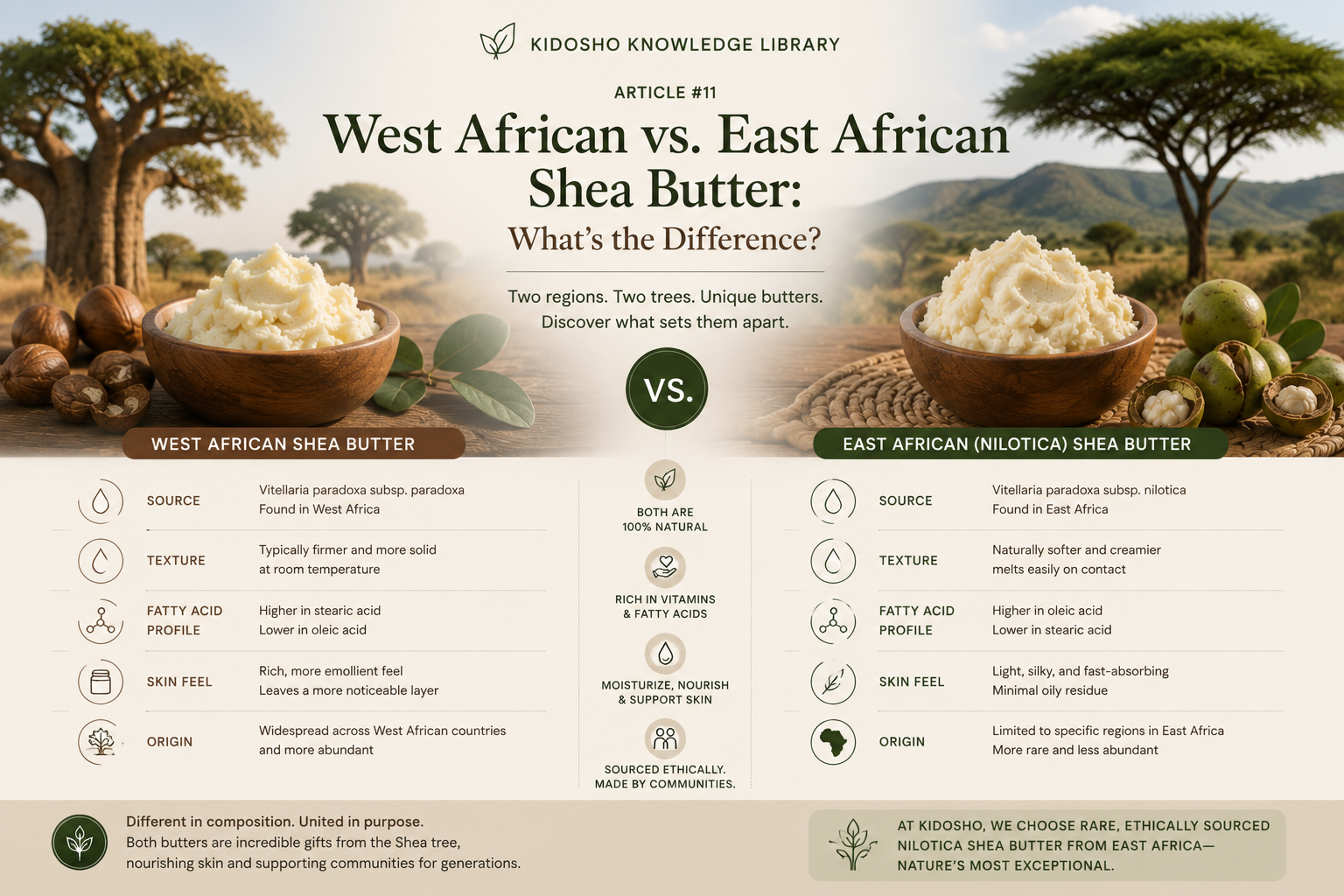
One Tree. Two Remarkable Butters.
Not all Shea Butter is the same.
Although both West African and East African Shea Butter come from the African Shea tree, they originate from different subspecies, grow in different climates, and possess distinct natural characteristics.
Neither is inherently “better.”
Each has qualities that make it well suited for different applications.
At KIDOSHO, we’ve chosen East African Nilotica Shea Butter because its naturally creamy texture and elegant feel align with our philosophy of simple, luxurious skincare.
Understanding the differences helps you choose the Shea Butter that’s right for your needs.
In This Article
You’ll learn:
- Why there are two primary types of Shea Butter
- How their growing regions differ
- Differences in texture and composition
- How each performs on the skin
- Why KIDOSHO chose Nilotica Shea Butter
- What scientific research says
Two Subspecies, One Remarkable Tree
The African Shea tree belongs to the species Vitellaria paradoxa.
Within that species are two recognized subspecies:
West African Shea
Vitellaria paradoxa subsp. paradoxa
Native to much of West Africa, including countries such as:
- Ghana
- Burkina Faso
- Mali
- Benin
- Côte d’Ivoire
- Nigeria
This is the source of most Shea Butter sold worldwide.
East African Shea
Vitellaria paradoxa subsp. nilotica
Native primarily to:
- Uganda
- South Sudan
- Northwestern Kenya
- Parts of Ethiopia
This is the rare Shea Butter used in every KIDOSHO product.
As discussed in Article #7: The Nilotica Shea Tree, its limited geographic range makes Nilotica considerably less common.
A Tale of Two Landscapes
Climate plays an important role in shaping the characteristics of Shea Butter.
West African Shea trees generally grow across broad savannah parklands stretching thousands of miles across West Africa.
Nilotica Shea trees grow within a much smaller East African ecosystem characterized by different rainfall patterns, soils, and environmental conditions.
Over thousands of years, these differences have influenced the composition of the butter produced by each subspecies.
The Biggest Difference: Fatty Acid Composition
The most important scientific difference lies in their natural fatty acid profiles.
West African Shea Butter
Typically contains:
- Higher stearic acid
- Lower oleic acid
This contributes to a firmer butter that remains more solid at room temperature.
East African Nilotica Shea Butter
Typically contains:
- Higher oleic acid
- Lower stearic acid
This contributes to a softer, creamier butter that melts readily at body temperature.¹
Although natural variation occurs from tree to tree and harvest to harvest, this difference is consistently recognized in scientific literature.
How They Feel on the Skin
Because of these compositional differences, the two butters often provide different user experiences.
West African Shea Butter
Many people describe it as:
- firm
- dense
- rich
- highly protective
- slower to melt
It is commonly used in:
- body butters
- balms
- soaps
- lip care
- products designed for very dry areas
East African Nilotica Shea Butter
Many users describe it as:
- naturally soft
- creamy
- silky
- easy to spread
- quick to melt
It is frequently chosen for:
- facial skincare
- daily body moisturizing
- massage
- sensitive skin routines
- lightweight luxury formulations
Absorption and Skin Feel
One of the most noticeable differences for many users is how each butter feels after application.
Nilotica Shea Butter’s naturally higher oleic acid content allows it to spread easily and absorb comfortably, often leaving less of the waxy or heavy sensation associated with firmer botanical butters.
This elegant texture is one of the reasons luxury skincare brands increasingly value Nilotica Shea Butter.
Individual experiences vary, but many people appreciate its lightweight finish for everyday use.
Shared Benefits
Despite their differences, both types of Shea Butter share many characteristics.
Both naturally contain:
- triglycerides
- oleic acid
- stearic acid
- linoleic acid
- palmitic acid
- tocopherols (vitamin E)
- phytosterols
- triterpenes
Both function as effective emollients that help soften skin and support the skin’s natural moisture barrier.²
The difference is less about what they contain and more about the relative proportions of those naturally occurring components.
Which One Is Better?
This is one of the questions we hear most often.
The answer depends on what you’re looking for.
If your priority is:
- a firm butter for balms and body products, West African Shea Butter may be an excellent choice.
If your priority is:
- a naturally creamy texture
- smooth application
- fast melting
- everyday facial and body care
you may prefer East African Nilotica Shea Butter.
Neither is universally superior.
They simply offer different experiences.
Why KIDOSHO Chose Nilotica
At KIDOSHO, we wanted a Shea Butter that reflected our philosophy of uncomplicated luxury.
We chose 100% pure Nilotica Shea Butter because it offers:
- a naturally creamy texture
- effortless application
- elegant skin feel
- excellent spreadability
- rich moisturizing properties
- minimal processing
It allows us to offer a product that feels luxurious while remaining true to nature.
Beyond Texture: A Story of Place
Choosing Nilotica Shea Butter is also a celebration of East Africa.
Its story is rooted in:
- wild-growing Shea trees
- generations of traditional knowledge
- community stewardship
- sustainable harvesting
- responsible sourcing
As we’ve explored throughout the KIDOSHO Knowledge Library, every jar reflects both remarkable biology and remarkable people.
What the Research Says
Scientific studies consistently distinguish the two Shea subspecies based on their geographic distribution and fatty acid composition.
Research shows that Vitellaria paradoxa subsp. nilotica generally contains a higher proportion of oleic acid and a lower proportion of stearic acid than Vitellaria paradoxa subsp. paradoxa. This contributes to Nilotica Shea Butter’s softer consistency and lower melting point.¹
Both subspecies contain naturally occurring tocopherols (vitamin E), phytosterols, triterpenes, and essential fatty acids that contribute to their value as cosmetic moisturizers.²
Researchers also note that natural variation exists within both subspecies due to genetics, climate, soil conditions, and processing methods. No two harvests are chemically identical, making Shea Butter a truly natural ingredient.³
Frequently Asked Questions
Is Nilotica Shea Butter better than West African Shea Butter?
Neither is objectively better.
They simply have different natural characteristics. Many people prefer Nilotica Shea Butter for its softer texture and faster absorption, while others prefer the firmer consistency of West African Shea Butter.
Why is Nilotica Shea Butter softer?
Its naturally higher oleic acid content and lower stearic acid content contribute to its creamy texture and lower melting point.
Is West African Shea Butter less effective?
No.
Both subspecies are effective moisturizers and contain similar beneficial compounds. The primary differences relate to texture, fatty acid balance, and sensory experience.
Why is Nilotica Shea Butter less common?
Its natural growing range is much smaller than that of West African Shea trees, resulting in lower overall production.
Which Shea Butter does KIDOSHO use?
Every KIDOSHO product contains 100% pure East African Nilotica Shea Butter.
Key Takeaways
- African Shea trees include two primary subspecies: paradoxa and nilotica.
- West African Shea Butter is generally firmer because of its higher stearic acid content.
- East African Nilotica Shea Butter is naturally creamier because of its higher oleic acid content.
- Both provide excellent moisturizing properties and support the skin barrier.
- KIDOSHO chooses Nilotica Shea Butter for its luxurious texture, elegant skin feel, and East African heritage.
Related Articles
Previously in the KIDOSHO Knowledge Library
← Article #1: What Is Nilotica Shea Butter?
← Article #2: Why Nilotica Shea Butter Is Different
← Article #3: From Tree to Jar: The Journey of Pure Nilotica Shea Butter
← Article #7: The Nilotica Shea Tree
Continue Reading
→ Article #12: Pure Shea Butter: One Ingredient, Many Benefits
You may also enjoy:
- Benefits of Shea Butter for Dry Skin (Article #4)
- How Shea Butter Moisturizes Skin (Article #6)
- The Communities Behind KIDOSHO (Article #8)
- Supporting Women Through Ethical Sourcing (Article #9)
References
- Maranz, S., Wiesman, Z., Bisgaard, J., & Bianchi, G. (2004). Germplasm Resources of Vitellaria paradoxa Based on Variations in Fat Composition Across the Species Distribution Range. Agroforestry Systems. This landmark study documents the differences in fatty acid composition between the two Shea subspecies.
- Zhang, X., et al. (2026). Shea Butter: A Comprehensive Review of Its Compositions, Processing, Applications, and Challenges. Journal of the American Oil Chemists’ Society.
- Hall, J. B., Aebischer, D. P., Tomlinson, H. F., Osei-Amaning, E., & Hindle, J. R. (1996). Vitellaria paradoxa: A Monograph. University of Wales, Bangor.
- ScienceDirect Topics. Shea Butter (Vitellaria paradoxa): Composition, Properties and Applications.
About KIDOSHO
At KIDOSHO, we believe that understanding an ingredient’s origin helps you appreciate its true value.
Our 100% pure, ethically sourced Nilotica Shea Butter is chosen not because it is the only exceptional Shea Butter, but because its naturally creamy texture, elegant skin feel, and East African heritage reflect the experience we want to create for our customers.
Through the KIDOSHO Knowledge Library, we celebrate both the science and the story behind every jar—helping you discover why nature’s finest ingredients deserve to be understood as much as they are enjoyed.
Natural is the New Beautiful.