
Does Shea Butter Clog Pores? Understanding Comedogenicity and Your Skin

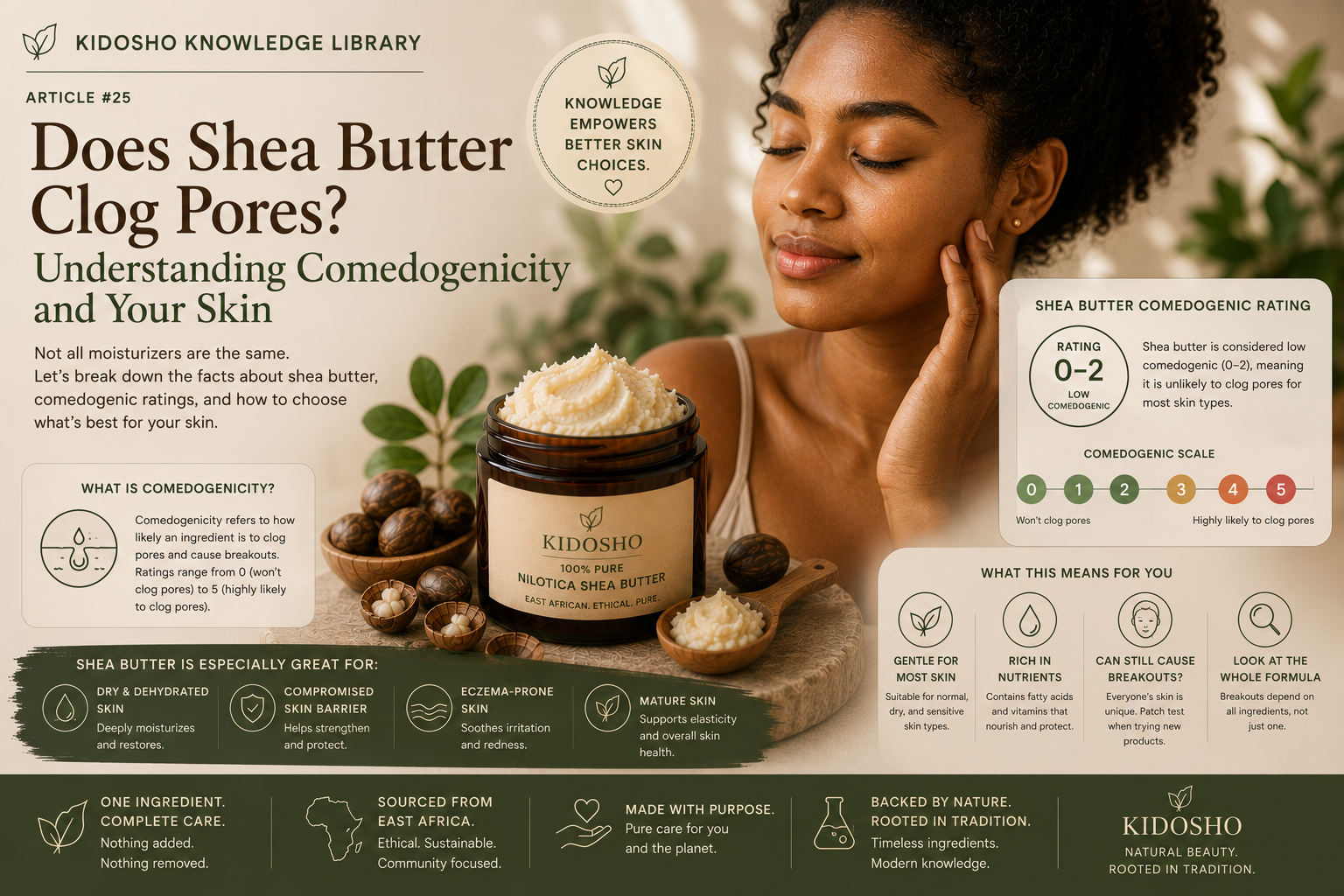
One of the Most Common Questions in Skincare
If you’ve ever searched for Shea Butter online, you’ve probably seen conflicting advice.
“Shea Butter clogs pores.”
“No, it doesn’t.”
“It’s safe for acne.”
“Avoid it if you have oily skin.”
So which is true?
Like many skincare questions, the answer isn’t simply yes or no.
Whether a product contributes to clogged pores depends on many factors, including your skin type, how much you use, the overall formulation, and your individual biology.
At KIDOSHO, we believe understanding the science behind comedogenicity is more helpful than relying on internet myths.
In This Article
You’ll learn:
- What clogged pores are
- What “comedogenic” means
- Whether Shea Butter is considered comedogenic
- Why skin type matters
- How to use Shea Butter on the face
- What scientific research says
What Are Pores?
Pores are tiny openings on the surface of your skin.
Each pore is connected to a hair follicle and a sebaceous (oil) gland.
These glands produce sebum, a natural oil that helps protect and lubricate the skin.
Healthy pores are essential.
The goal isn’t to “close” them—they don’t actually open and close—but to keep them functioning normally.
What Causes Clogged Pores?
A clogged pore develops when material builds up inside the follicle.
This may include:
- excess sebum
- dead skin cells
- bacteria
- cosmetic residues
- environmental debris
If the blockage remains beneath the skin, it may appear as a whitehead.
If the material becomes exposed to air and oxidizes, it may appear darker, forming what we commonly call a blackhead.
Acne is a complex condition influenced by many interacting factors—not simply by using a single skincare ingredient.
What Does “Comedogenic” Mean?
A comedogenic ingredient is one that has the potential to contribute to the formation of comedones (blackheads or whiteheads) in some individuals.
It is important to understand that comedogenicity is not an absolute property.
An ingredient is not universally pore-clogging for every person.
Instead, it reflects the likelihood that an ingredient may contribute to clogged pores under certain conditions.
The Limits of Comedogenic Ratings
You may have seen products assigned a “comedogenic rating” from 0 to 5.
Although widely shared online, these ratings should be interpreted with caution.
Many originated from older laboratory studies that:
- used animal models rather than human facial skin
- tested isolated ingredients at very high concentrations
- evaluated ingredients under conditions that differ from normal cosmetic use
Modern dermatologists generally consider these ratings a rough guide rather than a definitive predictor of how a product will perform on your skin.
Is Shea Butter Considered Comedogenic?
Current scientific evidence does not support labeling pure Shea Butter as universally pore-clogging.
Many dermatologists consider Shea Butter to have low to moderate comedogenic potential, but real-world experience varies considerably from person to person.
Several characteristics influence its behavior:
- it melts at body temperature
- it spreads easily over the skin
- it functions primarily as an emollient
- it helps reduce moisture loss without forming an excessively heavy film
Importantly, East African Nilotica Shea Butter has a softer texture and a higher oleic acid content than many West African Shea Butters, allowing it to spread in thinner, lighter layers.
Skin Type Makes a Difference
No skincare ingredient behaves exactly the same on every face.
Dry Skin
People with dry skin often tolerate Shea Butter very well because they benefit from additional moisturization.
Normal Skin
Many individuals with normal skin can use small amounts comfortably as part of a regular moisturizing routine.
Combination Skin
Applying Shea Butter only to drier areas may be preferable.
Oily Skin
Some people with oily skin enjoy using small amounts, while others prefer lighter moisturizers.
Individual experience varies.
Acne-Prone Skin
Having acne does not automatically mean you must avoid Shea Butter.
However, introducing any new facial product gradually and monitoring your skin’s response is a sensible approach.
How to Use Shea Butter Without Overloading the Skin
Less is often more.
For facial use:
- cleanse gently
- warm a pea-sized amount between your fingertips
- apply a thin layer
- focus on dry areas
- allow it to absorb naturally
Applying excessive amounts of any moisturizer may leave the skin feeling heavy.
A small amount is usually sufficient.
Patch Testing Is Always Wise
Every person’s skin is unique.
Before using Shea Butter regularly on your face:
- apply a small amount to one area
- observe your skin for several days
- gradually increase use if your skin responds well
This approach is particularly helpful if you have sensitive or acne-prone skin.
More Than One Ingredient Matters
It’s important to distinguish between pure Shea Butter and finished skincare products.
Many commercial creams contain:
- fragrances
- waxes
- silicones
- oils
- emulsifiers
- preservatives
If a product contributes to breakouts, the cause may be the complete formulation rather than the Shea Butter itself.
That’s one reason ingredient transparency matters.
Why KIDOSHO Uses Pure Nilotica Shea Butter
Our philosophy is simple.
Rather than creating complex formulas with dozens of ingredients, we offer 100% pure East African Nilotica Shea Butter.
Its naturally creamy texture allows it to spread easily using very small amounts, making it suitable for many people seeking a minimalist moisturizer.
Because everyone’s skin is different, we encourage thoughtful use, patch testing, and adjusting your routine based on your individual skin’s needs.
What the Research Says
Acne develops through a combination of factors, including increased sebum production, abnormal shedding of skin cells within hair follicles, colonization by Cutibacterium acnes, and inflammation. No single cosmetic ingredient is solely responsible for causing acne.¹
The concept of comedogenicity originated from laboratory testing methods that have important limitations when applied to modern skincare products. Dermatologists increasingly recommend evaluating products based on their complete formulation and individual skin response rather than relying exclusively on historical comedogenic ratings.²
Shea Butter is a plant-derived emollient rich in naturally occurring fatty acids. Current evidence does not classify pure Shea Butter as universally pore-clogging, and many individuals—including some with acne-prone skin—use it successfully as part of a balanced skincare routine.³
Frequently Asked Questions
Does Shea Butter clog pores?
Not necessarily.
Current evidence does not support the idea that pure Shea Butter universally clogs pores. Individual skin type and how the product is used are important factors.
Is Shea Butter non-comedogenic?
There is no universally accepted classification. Rather than labeling it strictly “comedogenic” or “non-comedogenic,” it is more accurate to recognize that individual responses vary.
Can people with acne use Shea Butter?
Some people with acne-prone skin tolerate Shea Butter well, while others may prefer lighter moisturizers. Introduce it gradually and monitor your skin’s response.
Why do people say Shea Butter causes breakouts?
Breakouts may result from multiple factors, including the complete product formulation, excess application, existing acne, or individual skin characteristics—not necessarily the Shea Butter itself.
How much Shea Butter should I use on my face?
Usually a pea-sized amount is sufficient. Applying more is not necessarily better.
Key Takeaways
- Pores are a normal and essential part of healthy skin.
- Comedogenicity is not an absolute characteristic and varies between individuals.
- Historical comedogenic ratings have important scientific limitations.
- Current evidence does not support the claim that pure Shea Butter universally clogs pores.
- Using a small amount and patch testing are practical ways to determine how your skin responds.
- KIDOSHO’s 100% pure East African Nilotica Shea Butter offers a simple, transparent option for those seeking a natural facial moisturizer.
Related Articles
Previously in the KIDOSHO Knowledge Library
← Article #5: Sensitive Skin Guide: Is Shea Butter Right for You?
← Article #6: How Shea Butter Moisturizes Skin
← Article #15: Face vs. Body: Can You Use Shea Butter Everywhere?
← Article #19: What Makes Pure Shea Butter Unique?
← Article #24: The Science of Skin Barrier Function
You may also enjoy:
- Benefits of Shea Butter for Dry Skin (Article #4)
- Essential Fatty Acids Explained (Article #14)
- Daily Shea Butter Routine (Article #10)
- What Is Nilotica Shea Butter? (Article #1)
Continue Reading
→ Article #26: Shea Butter for Oily Skin: Can Moisturizing Reduce Over-Drying?
References
- Zaenglein, A. L., et al. (2016). Guidelines of Care for the Management of Acne Vulgaris. Journal of the American Academy of Dermatology.
- Draelos, Z. D. (2006). The Myth of Comedogenicity. Dermatologic Therapy. This review discusses the limitations of historical comedogenicity testing and emphasizes evaluating complete formulations and individual patient response.
- Lin, T.-K., Zhong, L., & Santiago, J. L. (2018). Anti-Inflammatory and Skin Barrier Repair Effects of Topical Application of Some Plant Oils. International Journal of Molecular Sciences.
- Zhang, X., et al. (2026). Shea Butter: A Comprehensive Review of Its Compositions, Processing, Applications, and Challenges. Journal of the American Oil Chemists’ Society.
- American Academy of Dermatology Association. Guidance on acne, moisturizers, and selecting skincare products for acne-prone skin.
About KIDOSHO
At KIDOSHO, we believe good skincare begins with informed decisions—not myths or marketing claims.
Our 100% pure, ethically sourced East African Nilotica Shea Butter is chosen for its naturally creamy texture, rich fatty acid profile, and exceptional versatility. Rather than making sweeping promises, we encourage you to understand your own skin, choose products thoughtfully, and build a routine that supports your skin’s natural balance.
Through the KIDOSHO Knowledge Library, we combine modern dermatological research with generations of East African botanical tradition, helping you care for your skin with confidence, clarity, and simplicity.
Natural is the New Beautiful.