
Face vs. Body: Can You Use Shea Butter Everywhere?

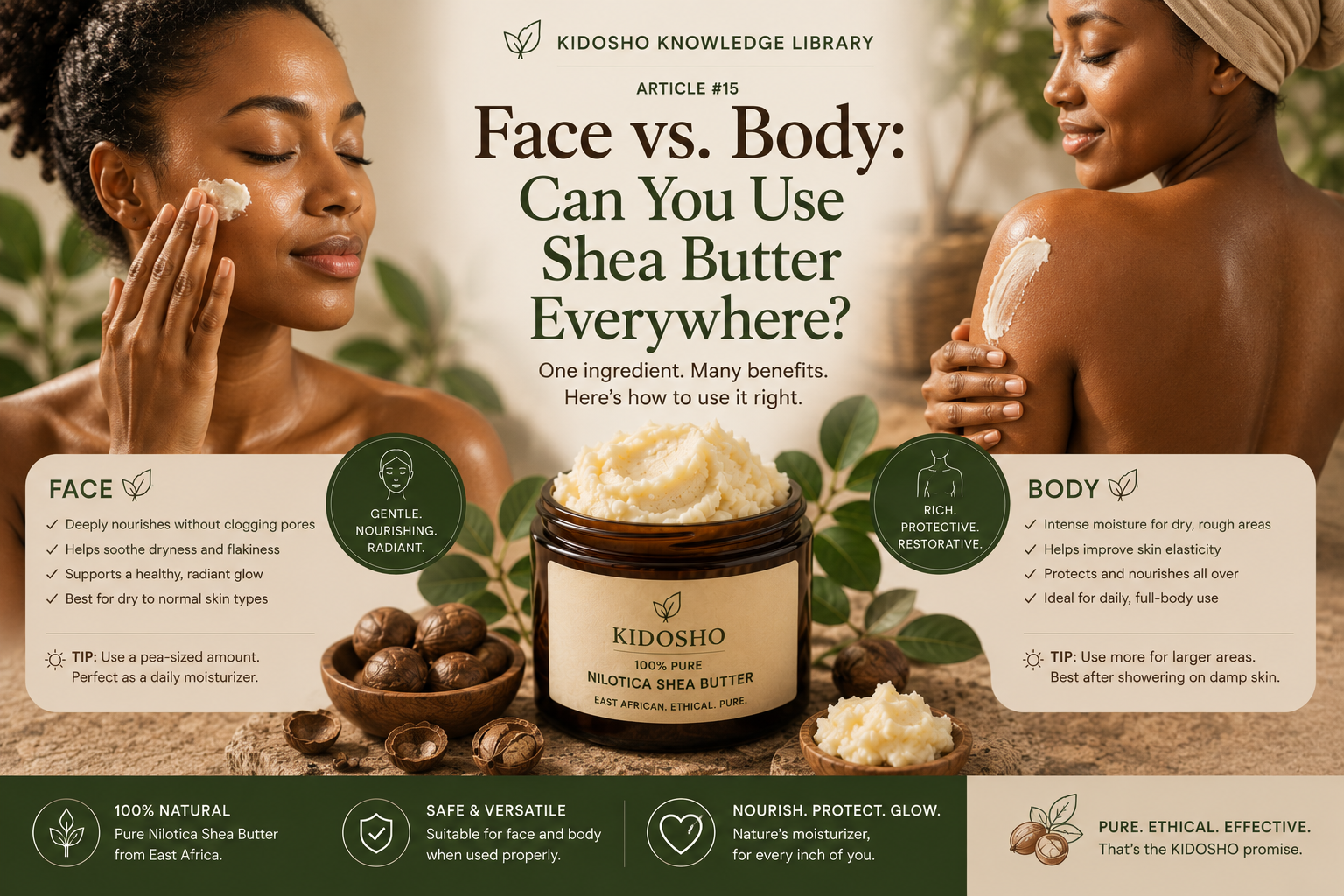
One Ingredient. Many Ways to Care for Your Skin.
Walk through any skincare aisle and you’ll find separate products for your face, hands, elbows, feet, neck, and body.
While different areas of the skin certainly have different needs, nature often begins with something much simpler.
Pure Nilotica Shea Butter is remarkably versatile. It can be used on many parts of the body, from dry hands and rough heels to the delicate skin of the face—provided it’s used thoughtfully and according to your skin’s individual needs.
At KIDOSHO, we believe understanding how to use an ingredient is just as important as choosing the ingredient itself.
In This Article
You’ll learn:
- Whether Shea Butter can be used on the face
- How facial skin differs from body skin
- The best way to apply Shea Butter to each area
- Tips for different skin types
- When to use more—or less
- What scientific research says
One Skin, Different Needs
Although the skin covers your entire body, it isn’t identical everywhere.
Different areas vary in:
- thickness
- oil production
- exposure to sunlight
- friction
- sensitivity
- moisture loss
Understanding these differences helps explain why you may apply Shea Butter differently depending on where you’re using it.
Facial Skin
The skin on your face is generally:
- thinner than many areas of the body
- more exposed to sun and pollution
- home to more sebaceous (oil) glands
- more susceptible to cosmetic concerns such as acne and sensitivity
Because facial skin is highly visible, many people prefer moisturizers that absorb comfortably without leaving a heavy residue.
As discussed in Article #11: West African vs. East African Shea Butter, Nilotica Shea Butter’s naturally higher oleic acid content gives it a softer texture and elegant skin feel that many users appreciate.
Body Skin
The body presents different challenges.
Areas such as the:
- elbows
- knees
- feet
- hands
experience greater friction and often lose moisture more quickly.
These areas typically benefit from richer moisturizers and slightly larger amounts of Shea Butter.
Can You Use Shea Butter on Your Face?
Yes.
Many people with normal to dry skin successfully use pure Shea Butter as part of their facial skincare routine.
Its naturally occurring fatty acids help soften the skin while supporting the skin’s moisture barrier.
Because Nilotica Shea Butter melts easily at body temperature, many users find that it spreads smoothly and absorbs comfortably.
However, skincare is personal.
If you have oily or acne-prone skin, you may prefer to:
- apply a smaller amount
- use it primarily at night
- focus on dry areas rather than the entire face
- introduce it gradually and observe how your skin responds
If you have persistent acne or another skin condition, consult a dermatologist for personalized advice.
Using Shea Butter Around the Eyes
The skin around the eyes is among the thinnest on the body.
If you choose to apply Shea Butter near this area:
- use a very small amount
- gently pat rather than rub
- avoid getting the product into your eyes
Because KIDOSHO contains no added fragrance or essential oils, many people appreciate its simplicity for delicate areas. Even so, avoid direct contact with the eyes.
Caring for Your Lips
Your lips naturally produce very little oil.
Cold weather, wind, dry air, and dehydration can quickly leave them feeling dry.
A tiny amount of pure Shea Butter can help soften and protect lips by reducing moisture loss.
Because only a small amount is needed, one jar can last a long time when used as a lip moisturizer.
Hands: One of the Hardest-Working Parts of the Body
Our hands encounter water, soap, sanitizer, cleaning products, and changing weather every day.
These factors can weaken the skin barrier.
Applying Shea Butter after washing your hands helps replenish moisture and improve skin comfort.
Keep a small jar nearby for convenient reapplication throughout the day.
Elbows, Knees, and Feet
These areas contain thicker skin and often experience greater friction.
For best results:
- apply a slightly more generous amount
- massage thoroughly
- reapply daily
Many people enjoy applying Shea Butter to their feet before bedtime and wearing cotton socks overnight to help maintain softness.
Neck and Décolletage
The neck and upper chest receive significant sun exposure but are sometimes overlooked in daily skincare.
These areas can benefit from the same gentle moisturizing routine used on the face.
Remember to apply sunscreen during the day, as Shea Butter is not a substitute for sun protection.
Adjust Your Routine to Your Skin
No two people have identical skin.
Your ideal routine may vary depending on:
- age
- climate
- season
- activity level
- skin type
- personal preference
Rather than following rigid rules, pay attention to how your skin feels.
Healthy skin usually tells you what it needs.
Less Product, Better Results
A common misconception is that using more moisturizer always produces better results.
With pure Nilotica Shea Butter, less is often more.
Start with a small amount.
Warm it between your fingertips.
Allow it to melt naturally before applying.
You can always add more if your skin needs additional moisture.
This approach helps achieve an even, comfortable application without leaving excess product on the skin.
What the Research Says
Scientific research recognizes Shea Butter as an effective emollient, meaning it helps soften the skin while supporting the skin’s natural moisture barrier. Its naturally occurring fatty acids—including oleic, stearic, linoleic, and palmitic acids—contribute to improved skin conditioning and reduced transepidermal water loss (TEWL).¹
Research also indicates that Nilotica Shea Butter generally contains a higher proportion of oleic acid than West African Shea Butter, contributing to its softer texture and smoother application.²
Although Shea Butter is widely used on both the face and body, individual skin types vary. People with acne-prone or highly reactive skin may benefit from introducing any new skincare product gradually and monitoring how their skin responds. Shea Butter is a cosmetic moisturizer and is not intended to diagnose, treat, cure, or prevent medical skin conditions.
Frequently Asked Questions
Can I use Shea Butter on both my face and body?
Yes.
Pure Nilotica Shea Butter can be used on many areas of the face and body, adjusting the amount according to each area’s needs.
Is Shea Butter too heavy for facial skin?
Not necessarily.
Many people with normal or dry skin find Nilotica Shea Butter comfortable because of its naturally creamy texture. Those with oily or acne-prone skin may prefer smaller amounts or nighttime use.
Can I use Shea Butter around my eyes?
Yes, but use only a very small amount and avoid direct contact with the eyes.
Why do my elbows and heels need more Shea Butter?
These areas experience greater friction and naturally lose more moisture, making them more prone to dryness.
Can one product replace multiple moisturizers?
For many people, yes.
Because Shea Butter is versatile, it can often simplify a skincare routine by serving as a moisturizer for several parts of the body. Individual skincare needs may still vary.
Key Takeaways
- Pure Nilotica Shea Butter can be used on both the face and body.
- Different areas of the skin have different moisturizing needs.
- Use smaller amounts on the face and more generous amounts on rougher areas like elbows and feet.
- Introduce any new skincare product gradually, especially if you have oily or sensitive skin.
- KIDOSHO’s 100% pure Nilotica Shea Butter offers a simple, versatile way to care for healthy-looking skin from head to toe.
Related Articles
Previously in the KIDOSHO Knowledge Library
← Article #4: Benefits of Shea Butter for Dry Skin
← Article #5: Sensitive Skin Guide: Is Shea Butter Right for You?
← Article #6: How Shea Butter Moisturizes Skin
← Article #10: Daily Shea Butter Routine
← Article #11: West African vs. East African Shea Butter
← Article #14: Essential Fatty Acids Explained
Continue Reading
→ Article #16: Does Shea Butter Clog Pores?
You may also enjoy:
- Understanding Vitamins A & E (Article #13)
- What Is Nilotica Shea Butter? (Article #1)
- From Tree to Jar (Article #3)
- How Nilotica Shea Is Harvested (Article #12)
References
- Elias, P. M. (2005). Stratum Corneum Defensive Functions: An Integrated View. Journal of Investigative Dermatology.
- Maranz, S., Wiesman, Z., Bisgaard, J., & Bianchi, G. (2004). Germplasm Resources of Vitellaria paradoxa Based on Variations in Fat Composition Across the Species Distribution Range. Agroforestry Systems.
- Zhang, X., et al. (2026). Shea Butter: A Comprehensive Review of Its Compositions, Processing, Applications, and Challenges. Journal of the American Oil Chemists’ Society.
- American Academy of Dermatology Association. Guidance on moisturizers, skin barrier care, and facial skincare routines.
About KIDOSHO
At KIDOSHO, we believe that exceptional skincare doesn’t require a cabinet full of products—it begins with one extraordinary ingredient used with intention.
Our 100% pure, ethically sourced Nilotica Shea Butter is crafted to care for skin wherever it needs nourishment, from delicate facial skin to hardworking hands and dry heels. By preserving the butter’s natural composition through careful sourcing and minimal processing, we deliver a versatile moisturizer inspired by generations of East African tradition.
Through the KIDOSHO Knowledge Library, we help you understand the science, heritage, and everyday practices that make simple skincare truly effective.
Natural is the New Beautiful.