
The Communities Behind KIDOSHO: Honoring the People Who Preserve a Timeless Tradition

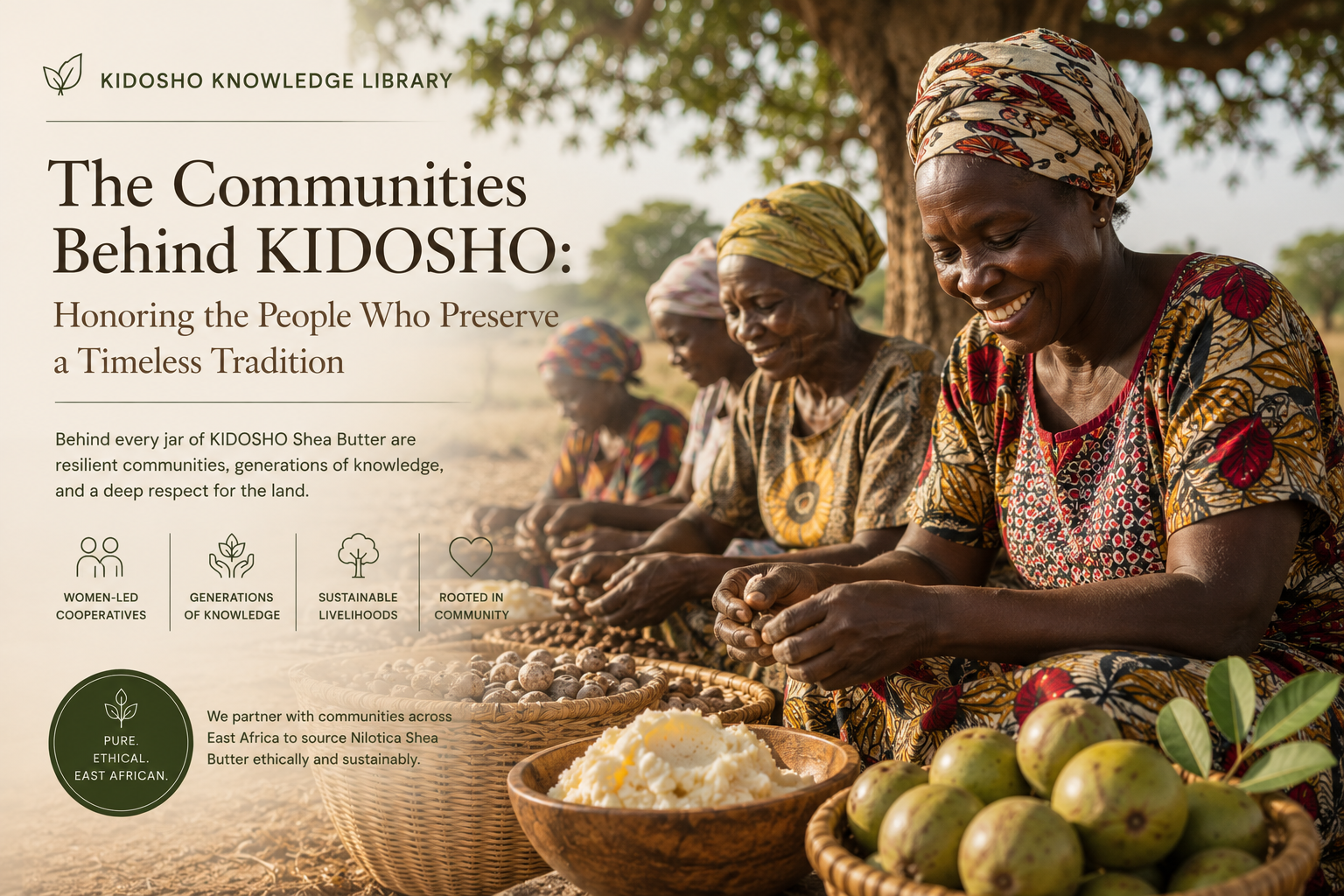
Behind Every Jar Is a Community
When you open a jar of KIDOSHO, you’re holding much more than pure Nilotica Shea Butter.
You’re holding the work of people.
Families who have lived alongside Shea trees for generations.
Communities that understand the rhythms of the seasons.
Knowledge passed from parents to children—not through textbooks, but through experience.
The story of KIDOSHO is not simply about skincare.
It’s about honoring the people whose care, patience, and craftsmanship make this remarkable ingredient possible.
In This Article
You’ll learn:
- Why communities are central to the story of Shea Butter
- How traditional knowledge has shaped Shea production
- The role of women in the Shea value chain
- What ethical sourcing means at KIDOSHO
- Why preserving communities helps preserve nature
- How your purchase creates positive impact
More Than an Ingredient
Earlier in the KIDOSHO Knowledge Library, we’ve explored:
- What Nilotica Shea Butter is (Article #1)
- Why Nilotica is unique (Article #2)
- How it travels from tree to jar (Article #3)
- The remarkable Nilotica Shea tree (Article #7)
But none of those stories can be told without the people who make them possible.
Unlike many industrial ingredients produced entirely by machines, Shea Butter begins with human hands.
People collect the fruit.
People prepare the kernels.
People preserve generations of traditional knowledge.
Communities remain at the heart of every step.
A Tradition Passed Through Generations
Long before Shea Butter became known around the world, communities across East Africa understood its value.
They knew:
- when the fruit was ready
- how to harvest without harming the tree
- how to dry the kernels
- how to produce high-quality butter
- how to care for the trees so future generations could benefit
This knowledge developed over centuries through observation and experience.
Today, much of that wisdom continues to guide sustainable Shea production.
The Important Role of Women
Across much of Africa, women have traditionally been the custodians of Shea production.
Depending on the region and community, women are often responsible for:
- collecting fallen fruit
- preparing the nuts
- drying the kernels
- producing Shea Butter
- maintaining quality
- selling Shea products in local markets
For many households, income from Shea contributes to:
- education
- healthcare
- household expenses
- food security
- small business development
Supporting ethical Shea sourcing means recognizing and valuing this contribution—not simply purchasing an ingredient.
Why Ethical Sourcing Matters
Ethical sourcing is more than paying for raw materials.
It means building relationships based on:
- respect
- transparency
- fair business practices
- long-term partnerships
- shared success
At KIDOSHO, ethical sourcing means looking beyond transactions.
It means recognizing that sustainable businesses are built together—with suppliers, processors, and communities—not at their expense.
Sustainability Begins with People
It’s easy to think about sustainability only in terms of protecting forests or reducing waste.
But environmental sustainability and community wellbeing are closely connected.
When communities benefit from healthy Shea trees, they have greater incentives to protect them.
Healthy trees support livelihoods.
Healthy livelihoods encourage conservation.
This relationship creates a positive cycle that benefits both people and the environment.
Respecting Traditional Knowledge
Modern science helps explain many of Shea Butter’s properties.
Traditional knowledge taught people how to use it long before laboratories could measure fatty acids or antioxidant compounds.
Neither replaces the other.
Instead, they complement one another.
At KIDOSHO, we value both:
- scientific research
- traditional craftsmanship
Together they tell a more complete story.
Building Long-Term Partnerships
Strong partnerships are built over time.
Rather than viewing suppliers as anonymous links in a supply chain, we believe they are collaborators in creating exceptional products.
Our sourcing philosophy emphasizes relationships that are:
- respectful
- transparent
- reliable
- mutually beneficial
- focused on long-term success
When communities thrive, product quality and environmental stewardship often improve as well.
Why Traceability Matters
Consumers increasingly want to know:
Where was this made?
Who produced it?
How was it sourced?
These are important questions.
While complete traceability varies across agricultural supply chains, responsible sourcing seeks greater transparency and accountability from harvest through production.
For us, knowing where our Shea comes from isn’t simply about logistics.
It’s about honoring the people behind it.
Every Purchase Tells a Story
Choosing ethically sourced products sends a message.
It says that quality matters.
That transparency matters.
That people matter.
Every purchase supports a system.
At KIDOSHO, we want that system to reflect our values:
- respect for nature
- respect for communities
- respect for craftsmanship
- respect for future generations
Our Commitment
As KIDOSHO grows, so does our responsibility.
Our goal is not simply to offer exceptional Nilotica Shea Butter.
Our goal is to build partnerships that create lasting value.
We are committed to continually strengthening our sourcing practices by focusing on:
- responsible procurement
- transparent relationships
- product quality
- environmental stewardship
- continuous learning
Ethical sourcing is not a destination.
It is an ongoing commitment.
What the Research Says
Research on the African Shea value chain consistently highlights the important role rural communities play in conserving Shea parklands and producing Shea Butter. Unlike plantation crops, Shea production depends heavily on traditional ecological knowledge and seasonal harvesting practices that have evolved over generations.¹
Studies also show that women are central participants in Shea collection, processing, and local trade across many producing regions. Income generated through Shea contributes to household welfare, food security, education, and community resilience.²
International organizations such as the Food and Agriculture Organization (FAO) and World Agroforestry (ICRAF) emphasize that sustainable Shea production depends on both ecological conservation and equitable participation by local communities. Protecting trees and supporting livelihoods are complementary goals rather than competing priorities.¹³
Frequently Asked Questions
Why are communities so important to Shea Butter production?
Most Shea Butter is still produced using traditional harvesting and processing methods that depend on local knowledge passed down through generations.
Why are women often highlighted in the Shea industry?
Across many Shea-producing regions, women have traditionally led the collection, processing, and marketing of Shea products, making them essential participants in the value chain.
What does ethical sourcing mean?
Ethical sourcing involves building responsible, transparent, and mutually beneficial relationships throughout the supply chain while respecting both people and the environment.
Does buying ethically sourced Shea Butter make a difference?
Supporting responsibly sourced products helps encourage sustainable business practices that value environmental stewardship, transparency, and fair partnerships.
How does KIDOSHO approach sourcing?
KIDOSHO is committed to sourcing 100% pure Nilotica Shea Butter through responsible partnerships that emphasize quality, transparency, and long-term relationships while continually improving our sourcing practices.
Key Takeaways
- Behind every jar of KIDOSHO is a community with generations of knowledge and craftsmanship.
- Traditional expertise remains essential to producing high-quality Nilotica Shea Butter.
- Women play a vital role throughout much of the Shea value chain across Africa.
- Sustainable sourcing depends on both environmental conservation and community wellbeing.
- KIDOSHO believes exceptional skincare begins with respect—for people, nature, and tradition.
Related Articles
Previously in the KIDOSHO Knowledge Library
← Article #1: What Is Nilotica Shea Butter?
← Article #2: Why Nilotica Shea Butter Is Different
← Article #3: From Tree to Jar: The Journey of Pure Nilotica Shea Butter
← Article #7: The Nilotica Shea Tree
Continue Reading
→ Article #9: Ethical Sourcing: Why It Matters in Natural Skincare
You may also enjoy:
- How Nilotica Shea Is Harvested (coming soon)
- From Tree to Jar (Article #3)
- The Nilotica Shea Tree (Article #7)
- Pure Shea Butter: One Ingredient, Many Benefits (coming soon)
References
- Food and Agriculture Organization (FAO). Publications on the Shea value chain, sustainable harvesting, community livelihoods, and natural resource management.
- World Agroforestry (ICRAF). Research on Shea parkland ecosystems, rural livelihoods, and community-based conservation.
- Hall, J. B., Aebischer, D. P., Tomlinson, H. F., Osei-Amaning, E., & Hindle, J. R. (1996). Vitellaria paradoxa: A Monograph. University of Wales, Bangor.
- Elias, M., & Carney, J. (2007). African Shea Butter: A Feminized Subsidy from Nature. Africa, 77(1), 37–62. This widely cited paper explores the social, economic, and cultural importance of Shea production, particularly the contributions of women across the value chain.
About KIDOSHO
KIDOSHO exists because of an extraordinary partnership between nature and people.
Our 100% pure, ethically sourced Nilotica Shea Butter begins with wild-growing Shea trees and the communities that have cared for them for generations. We believe that exceptional skincare is not created by ingredients alone—it is shaped by relationships, respect, and shared responsibility.
Through the KIDOSHO Knowledge Library, we celebrate not only the science of Shea Butter but also the people whose dedication keeps this remarkable tradition alive.
Natural is the New Beautiful.