
Shea Butter for Babies: Gentle Care for Delicate Skin

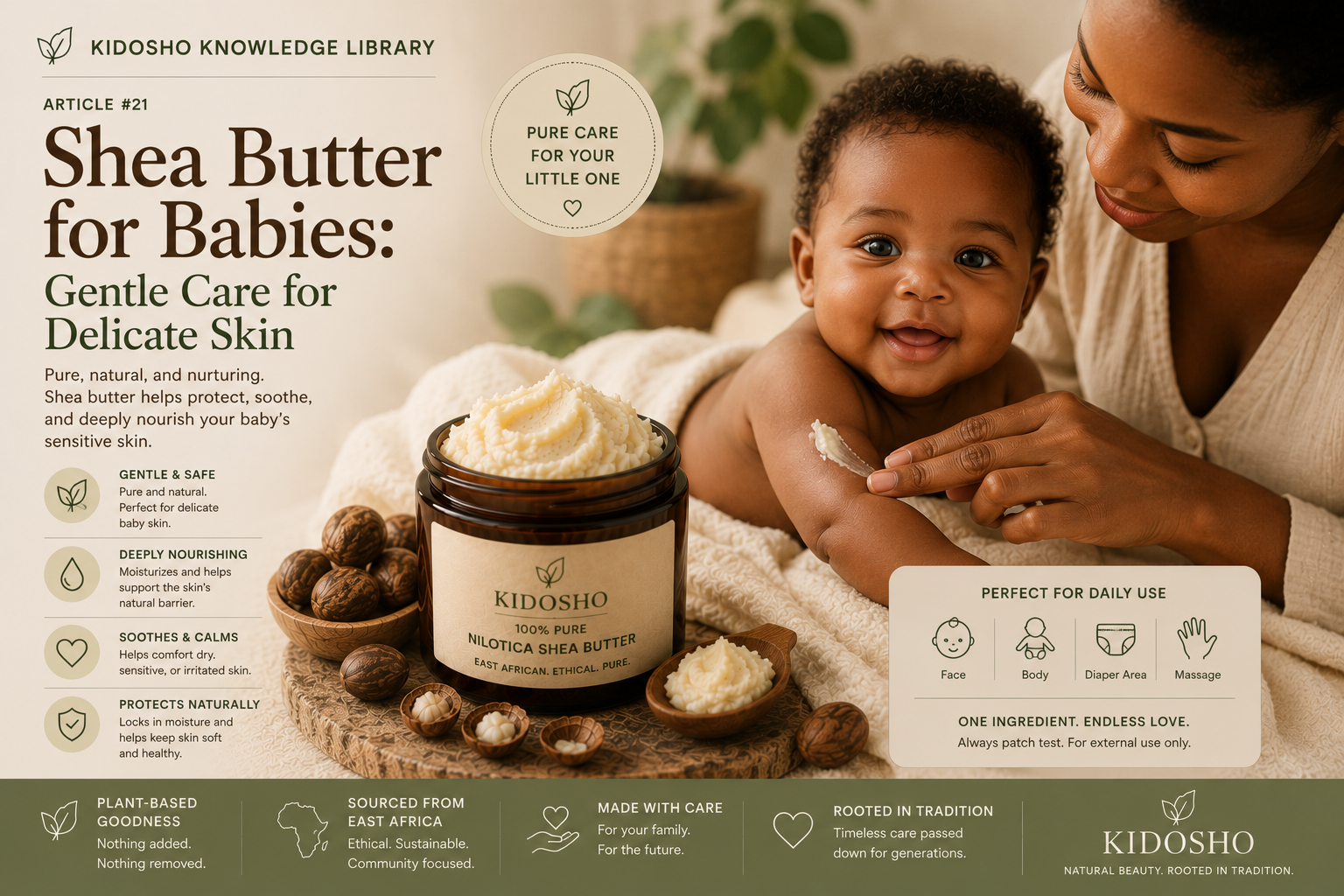
Gentle Care Begins with Gentle Ingredients
A baby’s skin is wonderfully soft—but it’s also remarkably delicate.
During the first months of life, a baby’s skin is still adapting to the outside world. It loses moisture more easily than adult skin and may become dry, rough, or irritated from everyday factors such as cool weather, low humidity, frequent bathing, or friction from clothing.
For many parents, choosing skincare products becomes less about finding the newest trend and more about finding products with simple, understandable ingredients.
That’s one reason 100% pure Nilotica Shea Butter has been used for generations in many African communities as a natural moisturizer for both adults and children.
At KIDOSHO, we believe caring for delicate skin begins with thoughtful, evidence-based choices.
In This Article
You’ll learn:
- Why baby skin is different
- Whether Shea Butter is appropriate for babies
- How to apply it safely
- Common uses for baby skincare
- When to speak with your pediatrician
- What scientific research says
Why Baby Skin Needs Extra Care
Although baby skin may appear perfect, it is still developing.
Compared with adult skin, infant skin is generally:
- thinner
- more delicate
- more prone to moisture loss
- more sensitive to environmental changes
- more susceptible to irritation from harsh ingredients
Because the skin barrier continues to mature during infancy, gentle moisturizing can help maintain skin comfort.
Is Pure Shea Butter Safe for Babies?
For healthy infants, 100% pure Shea Butter is generally considered appropriate as a cosmetic moisturizer when used externally on intact skin.
Its appeal lies in its simplicity.
KIDOSHO contains only one ingredient:
100% pure East African Nilotica Shea Butter.
There are:
- no added fragrances
- no artificial dyes
- no mineral oil
- no parabens
- no silicones
However, newborns—especially premature infants or babies with medical conditions—have unique skincare needs. Always follow your pediatrician’s recommendations regarding skincare products for your child.
Why Parents Choose Shea Butter
Parents often look for moisturizers that help relieve everyday dryness without unnecessary additives.
The naturally occurring fatty acids in Shea Butter help:
- soften dry skin
- reduce moisture loss
- support the skin’s natural barrier
- improve overall skin comfort
As discussed in Article #6: How Shea Butter Moisturizes Skin, Shea Butter functions as an emollient, helping smooth and condition the skin while supporting its natural protective barrier.
When Shea Butter May Be Helpful
Many parents choose to apply Shea Butter to areas that commonly become dry, including:
- cheeks
- arms
- legs
- elbows
- knees
- feet
It may be especially helpful during:
- colder months
- low-humidity environments
- after bathing
- periods of mild seasonal dryness
If your baby’s skin appears severely inflamed, cracked, oozing, or infected, seek medical advice rather than relying on cosmetic moisturizers.
A Simple Moisturizing Routine
Step 1
After bathing, gently pat your baby’s skin dry with a soft towel.
Avoid vigorous rubbing.
Step 2
Warm a very small amount of Shea Butter between your hands until it melts.
Step 3
Massage gently onto dry areas using slow, gentle movements.
A little goes a long way.
Step 4
Dress your baby in soft, breathable clothing after the moisturizer has been absorbed.
Bath Time and Moisture
Bathing removes dirt, sweat, and other impurities, but it can also remove some of the skin’s natural oils.
Many pediatric skincare recommendations suggest applying moisturizer shortly after bathing while the skin is still slightly damp.
This helps support the skin’s natural moisture barrier.
What About Diaper Areas?
Although some parents use Shea Butter on the diaper area as a skin protectant, diaper rash has many possible causes, including prolonged moisture exposure, friction, yeast infections, and bacterial infections.
Because diaper rashes vary considerably, it’s best not to assume Shea Butter is the appropriate solution for every situation.
If a diaper rash is persistent, severe, blistering, or accompanied by fever, consult your pediatrician.
Should You Perform a Patch Test?
Yes.
Even though Shea Butter is generally well tolerated, every baby’s skin is unique.
Before first use:
- apply a very small amount to a small area of skin
- wait 24 hours
- observe for redness or irritation
If irritation develops, discontinue use and consult your healthcare provider if needed.
Less Is Better
Babies don’t need large amounts of moisturizer.
A thin, even layer is usually sufficient.
Applying excessive amounts may simply leave excess product sitting on the skin rather than improving moisturization.
With pure Nilotica Shea Butter, a little truly goes a long way.
What Shea Butter Doesn’t Do
Honest information matters—especially when it comes to babies.
Pure Shea Butter is not:
- a treatment for eczema
- a cure for diaper rash
- a medicine
- an antibiotic
- a replacement for pediatric care
Its role is much simpler:
To help moisturize healthy or mildly dry skin as part of everyday skincare.
If your baby has persistent skin problems, your pediatrician can help determine the underlying cause and recommend appropriate treatment.
Why KIDOSHO Uses Pure Nilotica Shea Butter
When it comes to baby skincare, simplicity is reassuring.
Every jar of KIDOSHO contains one carefully selected ingredient:
100% pure, ethically sourced East African Nilotica Shea Butter.
Its naturally creamy texture melts easily in your hands, spreads gently across delicate skin, and helps support everyday moisturization without added fragrances or unnecessary ingredients.
What the Research Says
Infant skin differs structurally from adult skin and has a developing barrier that loses moisture more readily. Maintaining skin hydration with gentle moisturizers is an important part of routine infant skincare.¹
Shea Butter is recognized as an emollient rich in naturally occurring fatty acids that help support the skin barrier and reduce transepidermal water loss (TEWL).²
While moisturizers play an important role in maintaining healthy skin, they are not medications. Persistent rashes, signs of infection, or severe skin irritation in infants should always be evaluated by a healthcare professional.³
Frequently Asked Questions
Can I use Shea Butter on my baby’s skin every day?
Yes.
Many parents apply a small amount daily, particularly after bathing or when the skin appears dry.
Is Shea Butter safe for newborns?
Pure Shea Butter is generally used as a cosmetic moisturizer, but newborn skincare should always follow the guidance of your pediatrician, particularly for premature infants or babies with medical conditions.
Can Shea Butter help with dry baby skin?
Yes.
Its naturally occurring fatty acids help moisturize and soften dry skin while supporting the skin’s natural barrier.
Can I use Shea Butter for diaper rash?
Shea Butter may help moisturize skin, but diaper rash has many different causes. Persistent or severe diaper rash should be evaluated by your pediatrician.
Should I patch test Shea Butter before using it?
Yes.
Apply a small amount to a small area of skin and wait 24 hours before more extensive use.
Key Takeaways
- Baby skin is thinner and loses moisture more easily than adult skin.
- Pure Shea Butter is generally suitable as a cosmetic moisturizer for healthy infant skin.
- A small amount applied after bathing helps support the skin’s moisture barrier.
- Always perform a patch test before first use.
- Persistent skin concerns should be evaluated by a pediatrician.
- KIDOSHO’s 100% pure East African Nilotica Shea Butter provides a simple, fragrance-free moisturizing option for families seeking minimalist skincare.
Related Articles
Previously in the KIDOSHO Knowledge Library
← Article #4: Benefits of Shea Butter for Dry Skin
← Article #5: Sensitive Skin Guide: Is Shea Butter Right for You?
← Article #6: How Shea Butter Moisturizes Skin
← Article #10: Daily Shea Butter Routine
← Article #19: What Makes Pure Shea Butter Unique?
← Article #20: Shea Butter During Pregnancy
You may also enjoy:
- Face vs. Body: Can You Use Shea Butter Everywhere? (Article #15)
- Understanding Vitamins A & E (Article #13)
- Essential Fatty Acids Explained (Article #14)
- What Is Nilotica Shea Butter? (Article #1)
Continue Reading
→ Article #22: Shea Butter Through the Seasons: How Weather Affects Your Skin
References
- Blume-Peytavi, U., et al. (2016). Skin Care Practices for Newborns and Infants: Review of the Clinical Evidence for Best Practices. Pediatric Dermatology.
- Lin, T.-K., Zhong, L., & Santiago, J. L. (2018). Anti-Inflammatory and Skin Barrier Repair Effects of Topical Application of Some Plant Oils. International Journal of Molecular Sciences.
- American Academy of Pediatrics. Guidance on infant skin care, moisturizing, and when to seek medical evaluation for skin conditions.
- Zhang, X., et al. (2026). Shea Butter: A Comprehensive Review of Its Compositions, Processing, Applications, and Challenges. Journal of the American Oil Chemists’ Society.
About KIDOSHO
At KIDOSHO, we believe that the gentlest care begins with the simplest ingredients.
Our 100% pure, ethically sourced East African Nilotica Shea Butter is carefully sourced and minimally processed to preserve its naturally moisturizing fatty acids and plant compounds. With no added fragrance, fillers, or unnecessary ingredients, it offers a simple way to help care for dry skin across every stage of life—from infancy through adulthood.
Through the KIDOSHO Knowledge Library, we provide practical, evidence-based guidance to help families make informed skincare decisions grounded in both science and tradition.
Natural is the New Beautiful.