
Shea Butter Hair Mask Guide: Deep Conditioning for Soft, Healthy Hair

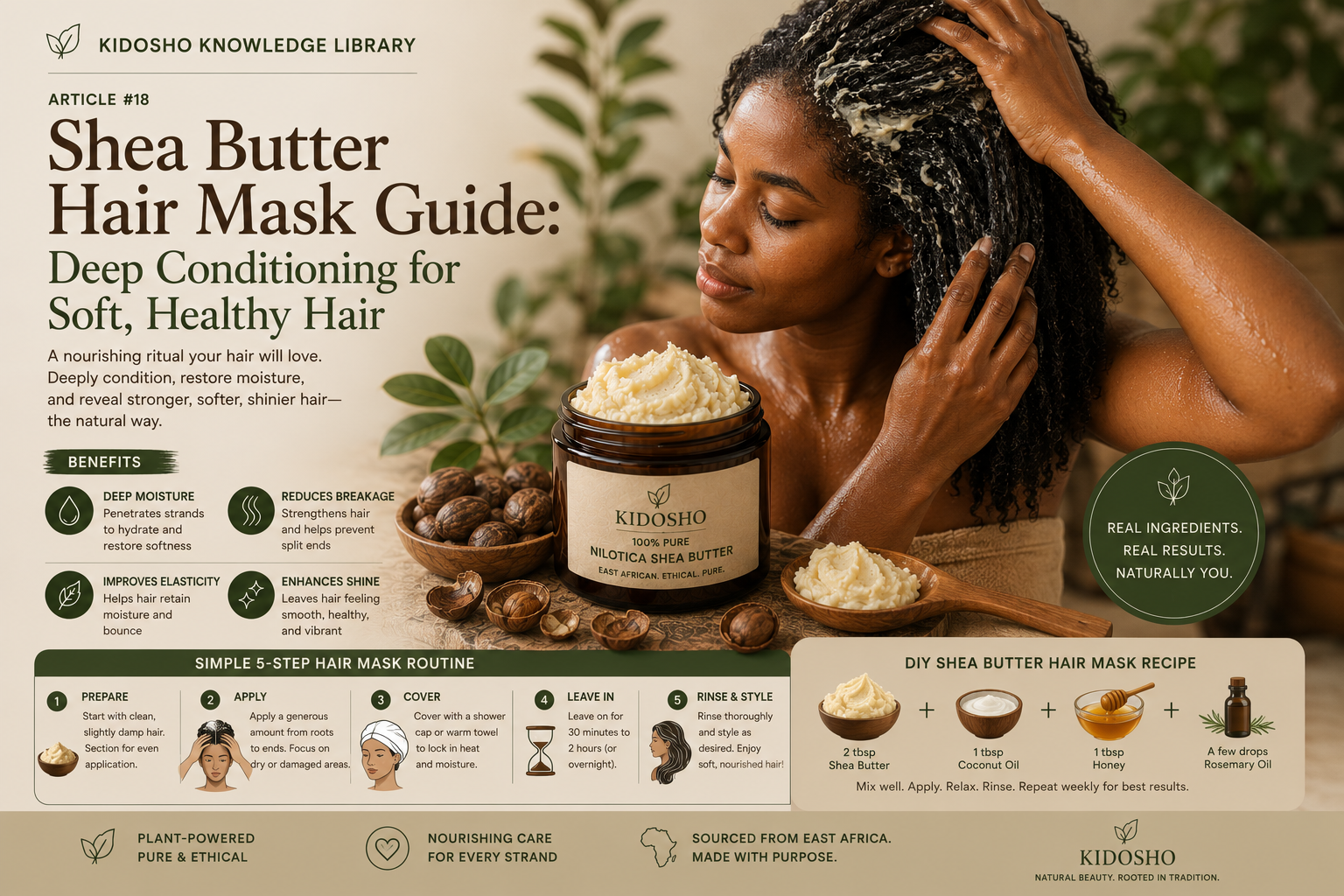
Give Your Hair Time to Recover
Daily life can be demanding on your hair.
Sunlight, wind, heat styling, shampooing, coloring, chlorine, and even brushing gradually strip away moisture. Over time, hair may begin to feel dry, rough, or difficult to manage.
While a daily moisturizer helps maintain hydration, sometimes your hair benefits from a little extra care.
That’s where a hair mask comes in.
Unlike a quick conditioner that’s rinsed away after a minute or two, a hair mask remains on the hair longer, giving moisturizing ingredients more time to coat the hair fibers and improve softness.
At KIDOSHO, we believe one thoughtfully chosen ingredient—100% pure Nilotica Shea Butter—can become the foundation of a simple and effective deep-conditioning routine.
In This Article
You’ll learn:
- What a hair mask is
- How Shea Butter works as a deep conditioner
- Which hair types benefit most
- A step-by-step hair mask routine
- How often to use one
- Common mistakes to avoid
- What scientific research says
What Is a Hair Mask?
A hair mask is an intensive conditioning treatment designed to provide more prolonged moisture than a typical rinse-out conditioner.
Most hair masks aim to:
- improve softness
- reduce dryness
- enhance manageability
- smooth the hair surface
- improve shine
- reduce friction between hair strands
Unlike chemical treatments, a moisturizing hair mask works on the surface of the hair shaft rather than permanently changing its structure.
Why Shea Butter Makes an Excellent Hair Mask
Pure Shea Butter is naturally rich in lipids that coat the hair fiber.
As discussed in Article #14: Essential Fatty Acids Explained, Nilotica Shea Butter contains naturally occurring:
- oleic acid
- stearic acid
- linoleic acid
- palmitic acid
These fatty acids help condition the hair surface while reducing moisture loss.
Nilotica Shea Butter is especially well suited for this purpose because its naturally creamy consistency makes it easy to melt, spread, and distribute through the hair.
Who Benefits Most?
A Shea Butter hair mask may be especially helpful for:
- dry hair
- curly hair
- coily hair
- textured hair
- color-treated hair
- heat-styled hair
- coarse hair
- chemically processed hair
People with very fine or naturally oily hair may still use Shea Butter but often achieve better results by applying smaller amounts primarily to the mid-lengths and ends.
Before You Begin
For the best results:
- detangle your hair gently
- start with clean or lightly damp hair
- warm the Shea Butter between your palms until it melts
- work in sections for even coverage
Because Nilotica Shea Butter melts close to body temperature, it spreads more easily than firmer botanical butters.
Step-by-Step Hair Mask Routine
Step 1: Warm the Butter
Scoop a small amount into your hands.
Rub your palms together until the Shea Butter becomes smooth and creamy.
Step 2: Apply to Mid-Lengths and Ends
Focus first on the driest parts of your hair.
These sections typically experience the greatest wear.
Work downward from the middle of the hair shaft toward the ends.
Step 3: Apply to the Scalp (Optional)
If your scalp feels dry, gently massage a small amount into the scalp using your fingertips.
If your scalp is naturally oily, you may prefer to skip this step.
Step 4: Comb Through
Use a wide-tooth comb to distribute the Shea Butter evenly throughout the hair.
This helps prevent concentrated areas while ensuring consistent coverage.
Step 5: Allow Time to Work
Leave the hair mask on for approximately 20–30 minutes.
Some people choose to leave it on longer or overnight, particularly when treating very dry hair.
If you do, protect your pillow with a towel or sleep cap.
Step 6: Shampoo and Condition
Wash your hair with a gentle shampoo.
Depending on your hair type and the amount of Shea Butter used, a second shampoo may be helpful.
Finish with your usual conditioner if desired.
How Often Should You Use a Hair Mask?
There is no universal schedule.
It depends on your hair.
Once per Week
Often suitable for:
- dry hair
- curly hair
- color-treated hair
Every Two Weeks
Often suitable for:
- normal hair
- moderately dry hair
Once per Month
May be sufficient for:
- healthy hair
- fine hair
- naturally oily hair
Rather than following strict rules, pay attention to how your hair responds.
Common Mistakes
Using Too Much
A little Shea Butter goes a long way.
Applying excessive amounts can make washing more difficult and may leave the hair feeling heavy.
Applying to Dirty Hair
Product buildup may reduce even distribution.
Starting with clean hair generally produces better results.
Skipping the Ends
Hair ends are usually the oldest and driest part of the hair.
They often benefit most from deep conditioning.
Expecting Instant Repair
A hair mask improves softness and manageability.
It cannot permanently repair split ends or reverse structural damage.
Consistent care over time is more realistic than expecting overnight transformation.
Pair Your Hair Mask with Healthy Habits
Deep conditioning works best alongside a healthy hair care routine.
Consider:
- limiting excessive heat styling
- protecting hair from prolonged sun exposure
- sleeping on a satin or silk pillowcase
- trimming damaged ends regularly
- using gentle cleansers
- avoiding unnecessary friction
Healthy habits support the benefits of moisturizing treatments.
Why KIDOSHO Uses Pure Nilotica Shea Butter
Many commercial hair masks contain dozens of ingredients.
Silicones.
Synthetic fragrances.
Artificial colors.
Preservatives.
KIDOSHO takes a simpler approach.
Our 100% pure Nilotica Shea Butter contains one carefully selected ingredient.
Its naturally occurring fatty acids, tocopherols (Vitamin E), and plant compounds provide versatile care for skin, scalp, and hair while remaining true to nature.
What the Research Says
Scientific studies recognize Shea Butter as a lipid-rich botanical ingredient composed primarily of oleic, stearic, linoleic, and palmitic acids. These naturally occurring fatty acids contribute to its conditioning properties and help improve the feel, softness, and manageability of hair fibers.¹
Research on hair cosmetics shows that conditioning agents work by coating the hair surface, reducing friction between strands, smoothing the cuticle, and improving combability. Lipid-rich plant ingredients, including Shea Butter, can contribute to these cosmetic effects.²
Although deep-conditioning treatments help improve the appearance and feel of dry hair, they do not permanently repair damaged hair fibers or reverse split ends. Because hair shafts are made of non-living keratin, consistent moisturizing and gentle handling are more effective long-term strategies than relying on any single treatment.³
Frequently Asked Questions
Can I leave Shea Butter on my hair overnight?
Yes.
Many people choose to leave a Shea Butter hair mask on overnight, especially if their hair is very dry. Protect your pillow with a towel or sleep cap and shampoo as needed the following day.
Should I apply Shea Butter to wet or dry hair?
Slightly damp hair often allows for easier distribution, but Shea Butter can also be applied to dry hair as a pre-shampoo treatment.
How long should I leave the hair mask on?
Approximately 20–30 minutes is sufficient for many people, although longer treatments may be preferred for particularly dry hair.
Will a Shea Butter hair mask repair split ends?
No.
It can temporarily improve the appearance and feel of damaged ends by coating the hair, but it cannot permanently repair split ends.
Can I use a Shea Butter hair mask every week?
Yes.
Weekly treatments are common for dry, curly, or textured hair. Adjust the frequency based on your individual hair type and needs.
Key Takeaways
- A Shea Butter hair mask provides intensive moisture for dry hair.
- Nilotica Shea Butter’s creamy texture makes it easy to distribute throughout the hair.
- Focus on the mid-lengths and ends, where hair is often driest.
- Weekly or biweekly treatments are sufficient for many hair types.
- Deep conditioning improves softness and manageability but does not permanently repair damaged hair.
- KIDOSHO’s 100% pure Nilotica Shea Butter offers a simple, natural approach to deep conditioning.
Related Articles
Previously in the KIDOSHO Knowledge Library
← Article #11: West African vs. East African Shea Butter
← Article #14: Essential Fatty Acids Explained
← Article #15: Face vs. Body: Can You Use Shea Butter Everywhere?
← Article #16: Using Shea Butter on Hair
← Article #17: Shea Butter for Beards
You may also enjoy:
- Daily Shea Butter Routine (Article #10)
- Benefits of Shea Butter for Dry Skin (Article #4)
- How Shea Butter Moisturizes Skin (Article #6)
- Understanding Vitamins A & E (Article #13)
Continue Reading
→ Article #19: Shea Butter for Curly and Coily Hair: Building a Moisture Routine
References
- Zhang, X., et al. (2026). Shea Butter: A Comprehensive Review of Its Compositions, Processing, Applications, and Challenges. Journal of the American Oil Chemists’ Society.
- Gavazzoni Dias, M. F. R. (2015). Hair Cosmetics: An Overview. International Journal of Trichology.
- Robbins, C. R. (2012). Chemical and Physical Behavior of Human Hair (5th ed.). Springer.
- Dias, M. F. R. G. (2015). Hair Care Cosmetics: From Traditional Shampoo to Modern Conditioning Systems. This body of work explains how conditioning agents improve lubrication, reduce friction, and enhance hair manageability.
About KIDOSHO
At KIDOSHO, we believe that deep care doesn’t have to be complicated.
Our 100% pure, ethically sourced Nilotica Shea Butter is naturally rich in moisturizing fatty acids that help soften hair, support scalp comfort, and improve manageability—without added fragrances, silicones, or fillers. By preserving Shea Butter’s natural composition through careful sourcing and minimal processing, we offer a versatile ingredient that fits seamlessly into both skin and hair care routines.
Through the KIDOSHO Knowledge Library, we combine traditional East African wisdom with modern scientific understanding to help you build simple, effective routines that nourish your hair naturally.
Natural is the New Beautiful.