
Shea Butter for Beards: A Natural Way to Soften, Condition, and Care

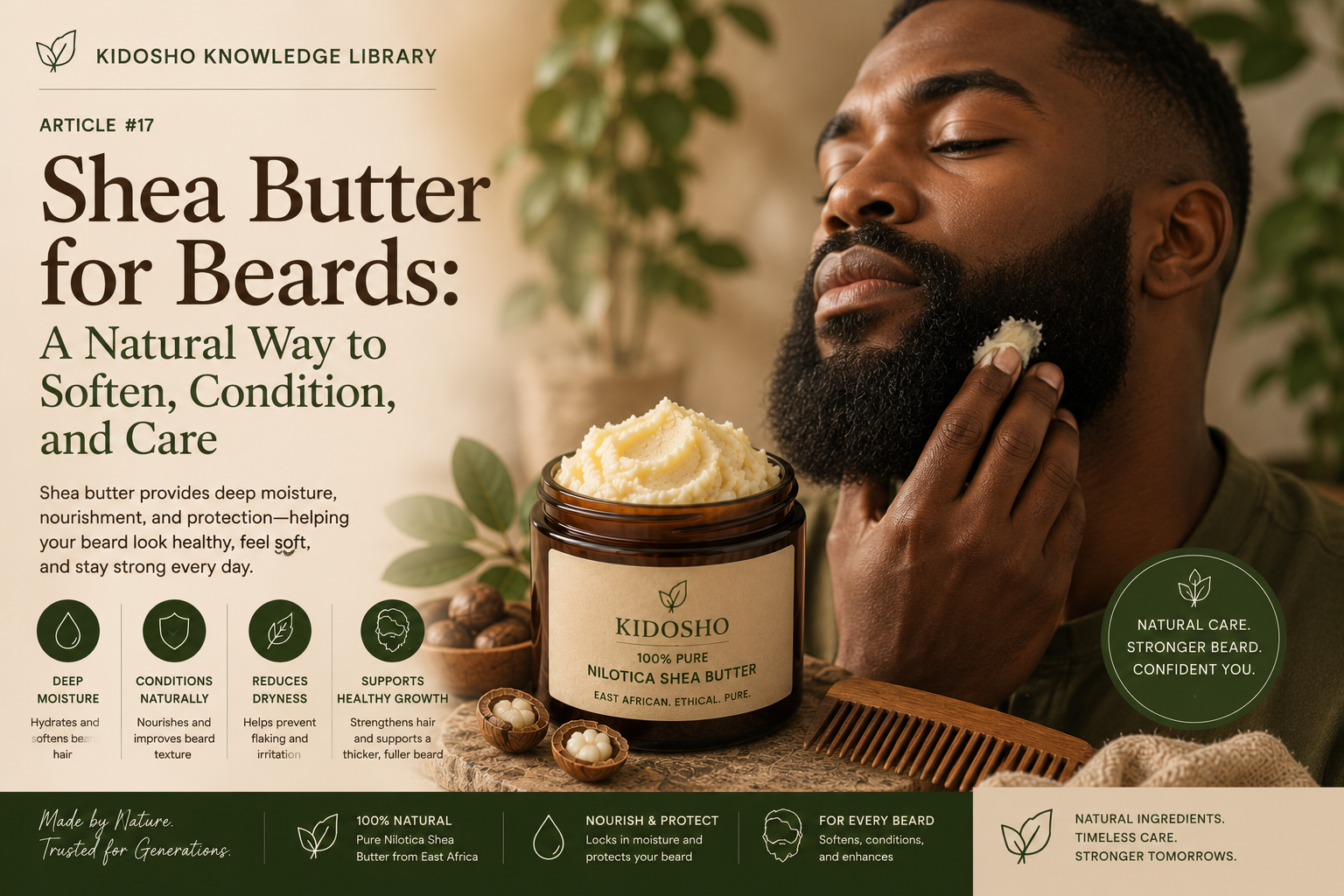
A Great Beard Starts with Healthy Skin
Growing a beard isn’t just about the hair you see.
It’s also about caring for the skin beneath it.
Dry skin can lead to beard itch, flaking, and an uncomfortable, unruly beard. Likewise, dry facial hair can become coarse, brittle, and difficult to manage.
For generations, natural plant butters have been used to moisturize both skin and hair. Today, 100% pure Nilotica Shea Butter offers a simple, versatile way to care for both—without unnecessary additives or complicated routines.
At KIDOSHO, we believe healthy-looking beards begin with healthy, well-moisturized skin.
In This Article
You’ll learn:
- How Shea Butter benefits beard hair
- Why the skin beneath your beard matters
- How to use Shea Butter as part of your beard routine
- Which beard types benefit most
- Common mistakes to avoid
- What scientific research says
Your Beard Is Hair—But It’s Different
Beard hair differs from the hair on your scalp.
It is often:
- coarser
- thicker
- curlier
- more susceptible to dryness
- exposed to food, weather, and frequent touching
At the same time, the skin beneath your beard can be harder to moisturize because facial hair limits direct access.
A good beard care routine addresses both the hair and the skin underneath.
Why Moisture Matters
A dry beard often feels:
- rough
- wiry
- stiff
- difficult to comb
- prone to tangling
Meanwhile, dry skin beneath the beard may contribute to:
- tightness
- visible flakes
- discomfort
- beard itch
While these symptoms can have multiple causes, maintaining good skin hydration is an important part of everyday beard care.
How Shea Butter Helps
Pure Shea Butter acts primarily as an emollient, helping soften both beard hair and the skin beneath it.
Its naturally occurring fatty acids help:
- improve beard softness
- reduce dryness
- smooth coarse hairs
- improve manageability
- support the skin’s natural moisture barrier
- reduce moisture loss from the skin
As discussed in Article #14: Essential Fatty Acids Explained, Shea Butter’s moisturizing performance comes from its naturally balanced blend of oleic, stearic, linoleic, and palmitic acids.
Why Nilotica Shea Butter Is Ideal for Beard Care
One reason many people enjoy Nilotica Shea Butter is its naturally creamy texture.
As explained in Article #11: West African vs. East African Shea Butter, Nilotica contains a higher proportion of oleic acid than many West African Shea Butters.
This contributes to:
- a softer consistency
- easier application
- smooth spreading
- quick melting between the hands
- less tugging during application
These characteristics make it particularly well suited for facial hair, where even distribution is important.
Caring for the Skin Beneath the Beard
Healthy-looking beards begin at the skin.
When moisturizing your beard:
- Warm a small amount of Shea Butter between your palms.
- Massage it gently into the skin beneath your beard.
- Work the remaining product through the beard from roots to tips.
- Finish by combing or brushing to distribute the butter evenly.
This routine helps condition both the skin and the hair.
Beard Itch and Dryness
Beard itch is common, particularly:
- during early beard growth
- in cold weather
- after frequent washing
- in dry climates
Moisturizing the skin beneath the beard may help improve comfort by reducing dryness.
However, persistent itching, redness, or scaling may indicate an underlying skin condition such as eczema, psoriasis, or seborrheic dermatitis. If symptoms continue, consult a dermatologist.
When to Apply Shea Butter
Many people prefer applying Shea Butter:
After Washing
Hair and skin are clean, and slightly damp skin helps lock in moisture.
Before Bed
An overnight application allows the butter to remain on the beard without exposure to wind, sunlight, or repeated touching.
Before Going Outdoors
Cold weather and low humidity can dry both beard hair and skin.
A small amount of Shea Butter helps maintain softness throughout the day.
Less Is More
One of the most common mistakes in beard care is using too much product.
Because Shea Butter is highly concentrated:
- begin with a pea-sized amount
- warm it completely between your palms
- apply evenly
- add more only if necessary
Using excessive amounts may leave the beard feeling greasy or weighed down.
Pair Shea Butter with Healthy Beard Habits
A healthy beard depends on consistent care.
Good habits include:
- washing with a gentle beard cleanser
- brushing or combing regularly
- trimming split ends
- staying hydrated
- eating a balanced diet
- avoiding excessive heat when drying
These practices work together with moisturizing ingredients to support a healthier-looking beard.
What Shea Butter Doesn’t Do
Honest grooming advice means avoiding exaggerated claims.
Current scientific evidence does not support claims that Shea Butter alone can:
- accelerate beard growth
- increase beard density
- change genetics
- fill patchy beards
- permanently alter hair texture
Its primary role is to help condition the beard, improve softness, and support healthy skin beneath the beard.
Why KIDOSHO Chooses Pure Nilotica Shea Butter
Many commercial beard products contain fragrances, silicones, mineral oils, or multiple synthetic ingredients.
At KIDOSHO, we take a simpler approach.
Our 100% pure Nilotica Shea Butter contains one ingredient:
Pure, ethically sourced Nilotica Shea Butter.
Its naturally occurring fatty acids, antioxidants, and creamy texture provide versatile care for skin, hair, and beards without unnecessary additives.
What the Research Says
Scientific research identifies Shea Butter as a lipid-rich botanical ingredient containing naturally occurring oleic, stearic, linoleic, and palmitic acids. These fatty acids contribute to its emollient properties, helping soften hair fibers and support the skin’s natural moisture barrier.¹
Research on hair conditioning shows that lipid-rich ingredients reduce friction between hair fibers, improve softness, and enhance manageability. While most studies focus on scalp hair, these conditioning principles also apply to beard hair, which is similarly composed of keratin.²
Current scientific evidence does not demonstrate that Shea Butter directly stimulates beard growth or increases hair follicle activity. Its primary benefits relate to moisturizing, conditioning, and improving the cosmetic appearance of beard hair and the underlying skin.³
Frequently Asked Questions
Can I use Shea Butter on my beard every day?
Yes.
Many people use a small amount daily to help maintain softness and reduce dryness.
Will Shea Butter help with beard itch?
If beard itch is caused by dry skin, moisturizing with Shea Butter may improve comfort. Persistent itching or skin irritation should be evaluated by a healthcare professional.
Does Shea Butter make beards grow faster?
No.
There is currently no strong scientific evidence that Shea Butter directly promotes beard growth. Its primary role is conditioning and moisturizing.
Can I use Shea Butter instead of beard oil?
Many people do.
Because Shea Butter moisturizes both the skin and beard hair, it can serve as a simple alternative or complement to beard oils, depending on personal preference.
Is Nilotica Shea Butter better for beards?
Many users appreciate Nilotica Shea Butter because its naturally soft texture makes it easy to warm, spread, and distribute through facial hair.
Key Takeaways
- Healthy-looking beards begin with healthy, moisturized skin.
- Shea Butter helps soften beard hair and support the skin beneath it.
- Nilotica Shea Butter’s creamy texture makes it easy to apply and distribute.
- Small amounts are usually all that’s needed.
- Shea Butter conditions beard hair but is not a treatment for beard growth.
- KIDOSHO’s 100% pure Nilotica Shea Butter provides a simple, natural approach to everyday beard care.
Related Articles
Previously in the KIDOSHO Knowledge Library
← Article #11: West African vs. East African Shea Butter
← Article #14: Essential Fatty Acids Explained
← Article #15: Face vs. Body: Can You Use Shea Butter Everywhere?
← Article #16: Using Shea Butter on Hair
You may also enjoy:
- Daily Shea Butter Routine (Article #10)
- Benefits of Shea Butter for Dry Skin (Article #4)
- Sensitive Skin Guide (Article #5)
- Understanding Vitamins A & E (Article #13)
Continue Reading
→ Article #18: Shea Butter Through the Seasons: Adjusting Your Skincare Year-Round
References
- Zhang, X., et al. (2026). Shea Butter: A Comprehensive Review of Its Compositions, Processing, Applications, and Challenges. Journal of the American Oil Chemists’ Society.
- Robbins, C. R. (2012). Chemical and Physical Behavior of Human Hair (5th ed.). Springer. This reference explains the structure of human hair fibers and how conditioning agents improve softness, lubrication, and manageability.
- Gavazzoni Dias, M. F. R. (2015). Hair Cosmetics: An Overview. International Journal of Trichology.
- Lin, T.-K., Zhong, L., & Santiago, J. L. (2018). Anti-Inflammatory and Skin Barrier Repair Effects of Topical Application of Some Plant Oils. International Journal of Molecular Sciences.
About KIDOSHO
At KIDOSHO, we believe that effective grooming begins with exceptional ingredients—not complicated formulas.
Our 100% pure, ethically sourced Nilotica Shea Butter is carefully sourced from East Africa and minimally processed to preserve its naturally occurring fatty acids and plant compounds. Whether you’re caring for your skin, hair, or beard, one ingredient can support a simple, thoughtful routine rooted in nature.
Through the KIDOSHO Knowledge Library, we share evidence-based insights that help you understand not only how to use Shea Butter, but why it has remained a trusted part of personal care for generations.
Natural is the New Beautiful.