
Using Shea Butter on Hair: A Natural Way to Nourish and Protect

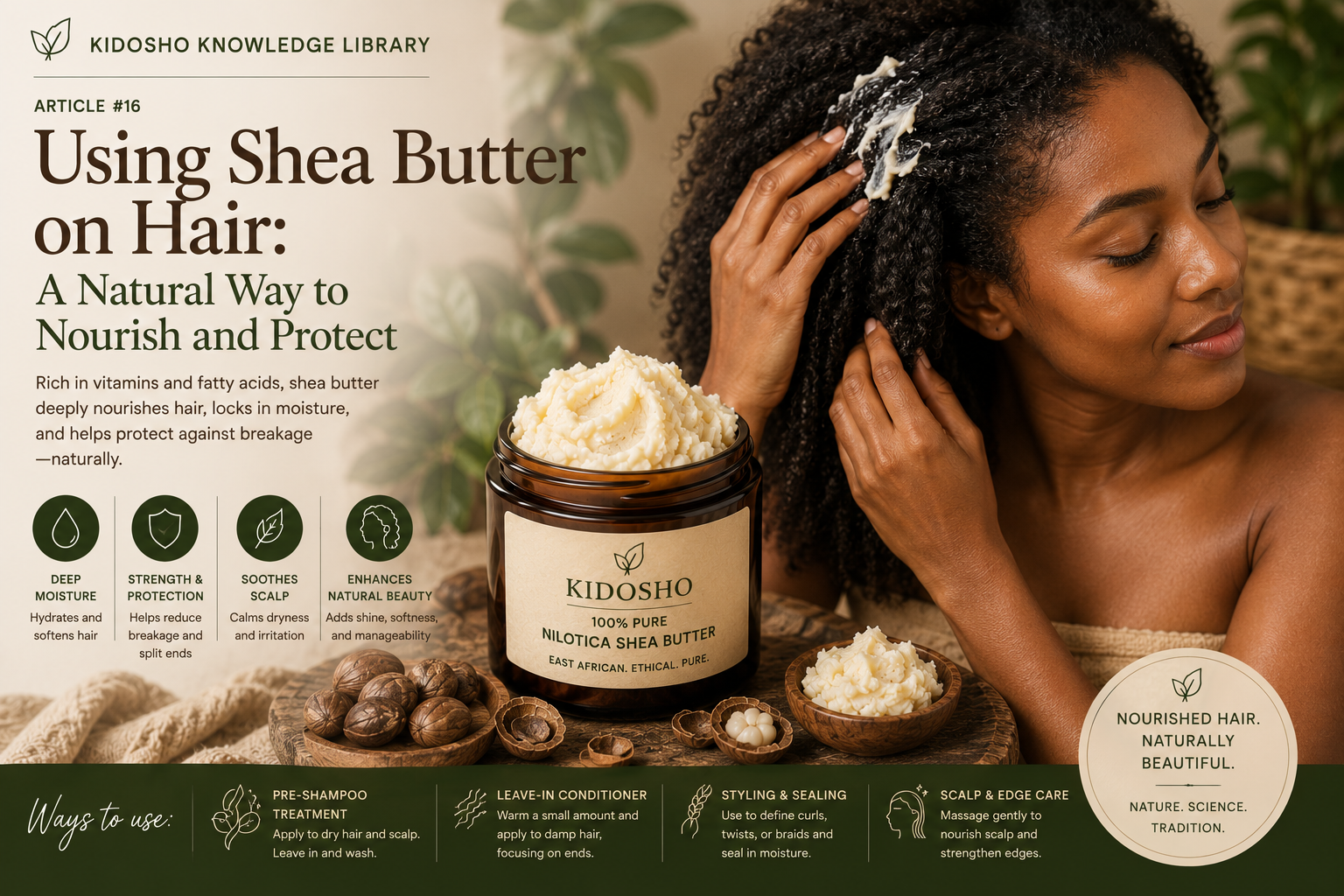
Healthy Hair Begins with Healthy Moisture
Beautiful hair isn’t just about styling products or salon treatments.
It starts with maintaining healthy moisture.
Dry, brittle hair is more prone to breakage, frizz, and a dull appearance. While genetics, climate, and hair type all play a role, choosing moisturizing ingredients can make a noticeable difference in how hair looks and feels.
For generations, communities across Africa have incorporated Shea Butter into hair care routines to help soften hair, improve manageability, and protect against dryness.
Today, 100% pure Nilotica Shea Butter continues that tradition with a naturally creamy texture that spreads easily through the hair without the graininess often associated with firmer botanical butters.
In This Article
You’ll learn:
- How Shea Butter benefits hair
- Whether it can be used on the scalp
- Which hair types benefit most
- How to apply Shea Butter correctly
- Common mistakes to avoid
- What scientific research says
Why Hair Needs Moisture
Hair is exposed to stress every day.
Heat styling, sun exposure, wind, washing, coloring, and chemical treatments gradually remove moisture from the hair shaft.
When hair loses moisture, it may become:
- dry
- rough
- frizzy
- difficult to manage
- more susceptible to breakage
Unlike living skin, the visible portion of the hair shaft cannot repair itself once damaged.
Moisturizing ingredients help improve the condition of the hair fiber and reduce further moisture loss.
How Shea Butter Helps Hair
Shea Butter is valued primarily as an emollient.
Rather than changing the internal structure of the hair, it coats the surface with naturally occurring lipids that help improve softness and reduce moisture loss.
Its naturally occurring fatty acids help:
- smooth the hair cuticle
- improve softness
- reduce dryness
- enhance manageability
- add natural-looking shine
- reduce the appearance of frizz
As discussed in Article #14: Essential Fatty Acids Explained, Shea Butter’s moisturizing properties come largely from its balanced blend of oleic, stearic, linoleic, and palmitic acids.
Why Nilotica Shea Butter Is Different
Not all Shea Butter feels the same.
As we explored in Article #11: West African vs. East African Shea Butter, Nilotica Shea Butter naturally contains a higher proportion of oleic acid.
This contributes to:
- a softer consistency
- easier spreading
- smoother application
- faster melting in the hands
For hair care, this means the butter is generally easier to distribute evenly through the hair.
Can You Use Shea Butter on Your Scalp?
Yes.
Many people apply a small amount of Shea Butter to a dry scalp to help reduce dryness and improve comfort.
Its moisturizing properties may help soften dry skin on the scalp, particularly during cold weather or in dry climates.
However, a healthy scalp is different from a healthy hairstyle.
If you have persistent itching, flaking, redness, or other scalp concerns, consult a dermatologist, as these symptoms may have underlying medical causes that require professional evaluation.
Which Hair Types Benefit Most?
Although Shea Butter can be used on many hair types, it is especially popular among people with hair that naturally requires additional moisture.
It is commonly used on:
- curly hair
- coily hair
- tightly textured hair
- thick hair
- dry or damaged hair
- chemically treated hair
People with very fine or naturally oily hair may prefer using smaller amounts, concentrating on the ends rather than applying it throughout the hair.
Simple Ways to Use Shea Butter on Hair
As a Leave-In Moisturizer
Warm a small amount between your palms until it melts.
Apply lightly to the mid-lengths and ends of slightly damp hair.
Avoid using more than necessary.
To Help Reduce Frizz
Rub a very small amount between your fingertips and smooth it gently over dry hair to tame flyaways.
Before Shampooing
Some people use Shea Butter as part of a pre-shampoo treatment.
Apply it to dry hair, leave it on for 20–30 minutes, then wash and condition as usual.
This may help reduce the drying effects of shampooing.
Overnight Hair Treatment
Apply a modest amount to dry hair, focusing on the ends.
Protect your pillow with a towel or sleep cap and wash or style your hair the following day if desired.
Less Is Usually More
One of the most common mistakes is using too much Shea Butter.
Because it is highly concentrated, a little goes a long way.
Using excessive amounts may leave hair feeling:
- heavy
- greasy
- difficult to style
Start with a pea-sized amount.
You can always apply more if needed.
Pair Shea Butter with Good Hair Habits
Healthy hair depends on more than a single product.
Consider combining Shea Butter with habits such as:
- minimizing excessive heat styling
- using gentle shampoos
- avoiding unnecessary friction
- protecting hair while sleeping
- trimming split ends regularly
- maintaining a balanced diet
Together, these practices help support healthier-looking hair over time.
What Shea Butter Doesn’t Do
Honest skincare—and hair care—means setting realistic expectations.
Shea Butter is not a miracle treatment.
Current scientific evidence does not support claims that Shea Butter alone can:
- permanently repair split ends
- regrow hair
- reverse hair loss
- treat scalp diseases
- permanently alter hair texture
Instead, its greatest strength lies in helping condition the hair, reduce dryness, and improve manageability.
Why KIDOSHO Uses Pure Nilotica Shea Butter
At KIDOSHO, simplicity is intentional.
Our products contain 100% pure Nilotica Shea Butter—nothing added, nothing unnecessary.
By preserving its naturally occurring fatty acids, tocopherols (Vitamin E), and other plant compounds, we offer a versatile ingredient that supports both skin and hair care.
Whether you’re moisturizing dry curls, smoothing flyaways, or caring for a dry scalp, pure Nilotica Shea Butter offers a naturally uncomplicated approach.
What the Research Says
Research recognizes Shea Butter as a lipid-rich botanical ingredient composed primarily of oleic, stearic, linoleic, and palmitic acids. These naturally occurring fatty acids contribute to its emollient properties and ability to improve the feel and manageability of hair fibers by reducing surface dryness.¹
Studies of plant oils and butters also suggest that lipid-rich ingredients can help reduce friction between hair fibers, improve softness, and decrease moisture loss from the hair shaft.²
While Shea Butter is widely used in hair care products, there is currently limited clinical evidence supporting claims that it promotes hair growth or treats medical scalp conditions. Its best-supported role is as a cosmetic conditioner that helps moisturize and soften hair.³
Frequently Asked Questions
Can I use Shea Butter on my hair every day?
Yes.
Many people use small amounts daily, particularly on dry ends or textured hair. Adjust the amount based on your hair type and desired finish.
Can Shea Butter be used on the scalp?
Yes.
A small amount may help moisturize a dry scalp. If you experience persistent scalp symptoms such as redness, significant flaking, or itching, consult a healthcare professional.
Is Shea Butter good for curly hair?
Many people with curly and coily hair appreciate Shea Butter because it helps improve softness, reduce frizz, and enhance manageability.
Will Shea Butter make my hair greasy?
Using too much can leave hair feeling heavy. Start with a very small amount and increase only if necessary.
Does Shea Butter make hair grow faster?
There is currently no strong scientific evidence that Shea Butter directly stimulates hair growth. Its primary benefit is moisturizing and conditioning the hair and scalp.
Key Takeaways
- Shea Butter helps moisturize and soften hair by coating the hair shaft with naturally occurring lipids.
- Nilotica Shea Butter’s creamy texture makes it easy to distribute through the hair.
- It is especially well suited for dry, curly, coily, and textured hair.
- Small amounts are usually sufficient for effective conditioning.
- Shea Butter supports healthy-looking hair but is not a treatment for hair loss or scalp disease.
- KIDOSHO’s 100% pure Nilotica Shea Butter offers a simple, natural solution for both skin and hair care.
Related Articles
Previously in the KIDOSHO Knowledge Library
← Article #11: West African vs. East African Shea Butter
← Article #12: How Nilotica Shea Is Harvested
← Article #13: Understanding Vitamins A & E
← Article #14: Essential Fatty Acids Explained
← Article #15: Face vs. Body: Can You Use Shea Butter Everywhere?
You may also enjoy:
- Daily Shea Butter Routine (Article #10)
- Benefits of Shea Butter for Dry Skin (Article #4)
- Sensitive Skin Guide (Article #5)
- How Shea Butter Moisturizes Skin (Article #6)
Continue Reading
→ Article #17: Shea Butter for Curly, Coily, and Textured Hair
References
- Zhang, X., et al. (2026). Shea Butter: A Comprehensive Review of Its Compositions, Processing, Applications, and Challenges. Journal of the American Oil Chemists’ Society.
- Gavazzoni Dias, M. F. R. (2015). Hair Cosmetics: An Overview. International Journal of Trichology. This review discusses how conditioning agents, including plant-derived lipids, improve hair manageability and reduce friction.
- Robbins, C. R. (2012). Chemical and Physical Behavior of Human Hair (5th ed.). Springer. A comprehensive reference on hair structure, conditioning, and cosmetic treatments.
- Lin, T.-K., Zhong, L., & Santiago, J. L. (2018). Anti-Inflammatory and Skin Barrier Repair Effects of Topical Application of Some Plant Oils. International Journal of Molecular Sciences. While focused on skin, this review provides insight into the emollient properties of plant-derived lipids.
About KIDOSHO
Healthy hair begins with healthy ingredients.
At KIDOSHO, our 100% pure, ethically sourced Nilotica Shea Butter is carefully selected for its naturally soft texture, rich fatty acid profile, and versatility. Whether you’re nourishing dry curls, smoothing frizz, or moisturizing your scalp, we believe that simple, minimally processed ingredients can play an important role in everyday hair care.
Through the KIDOSHO Knowledge Library, we combine traditional wisdom with modern scientific understanding to help you make informed choices for your skin, hair, and overall well-being.
Natural is the New Beautiful.