
The Nilotica Shea Tree: East Africa’s Living Treasure

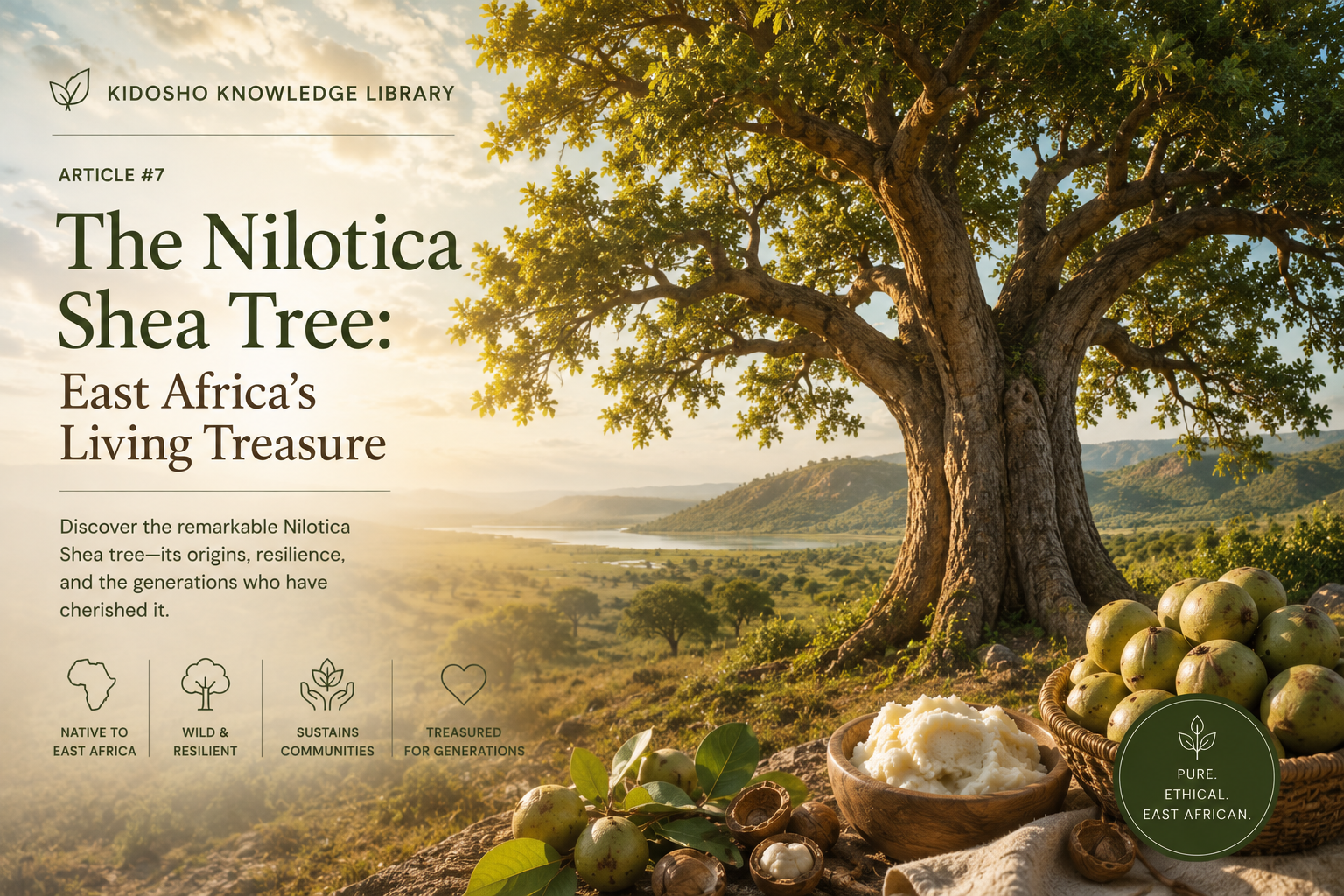
A Tree That Gives More Than Butter
Long before skincare products found their place on store shelves, one remarkable tree quietly sustained generations of families across East Africa.
It shaded villages.
It produced nutritious fruit.
It supported local livelihoods.
And inside every fruit grew the kernel that would become one of nature’s finest moisturizers—Nilotica Shea Butter.
Unlike many commercial crops grown for rapid harvest, the Nilotica Shea tree asks for patience. It may take decades before yielding its first significant crop, yet it can continue producing fruit for generations.
At KIDOSHO, every jar begins not in a factory, but with this extraordinary tree.
In This Article
You’ll learn:
- What the Nilotica Shea tree is
- Where it grows naturally
- Why it is different from other Shea trees
- How long it takes to mature
- Why it is important to local communities
- How conservation helps protect its future
Meet the Nilotica Shea Tree
The Nilotica Shea tree is a naturally occurring subspecies of the African Shea tree.
Scientific Name
Vitellaria paradoxa subsp. nilotica
As we discussed in Article #1: What Is Nilotica Shea Butter?, this tree produces the rare East African Shea Butter used in every KIDOSHO product.
Although it belongs to the same species as the more common West African Shea tree, it has evolved under different environmental conditions, resulting in fruit and kernels with their own distinctive characteristics.
Where Does It Grow?
The Nilotica Shea tree grows naturally within a relatively small region of East Africa.
Its native range includes parts of:
- Uganda
- South Sudan
- Northwestern Kenya
- Limited areas of Ethiopia
Unlike many agricultural crops, these trees are not typically planted in commercial orchards.
Instead, they grow wild across open savannahs and woodland ecosystems, where they have been part of the landscape for centuries.
This limited geographic range is one reason Nilotica Shea Butter is considerably rarer than its West African counterpart.
A Tree That Teaches Patience
Few commercially valuable trees require as much patience as the Shea tree.
A young Nilotica Shea tree may take 15 to 20 years before producing its first meaningful harvest.
Peak production often comes decades later.
Once mature, however, the tree may continue producing fruit for 50 years or more, with some trees believed to remain productive for well over a century under favorable conditions.¹
In a world focused on immediate results, the Shea tree reminds us that nature works on a different timetable.
Built for the African Savannah
The Nilotica Shea tree has adapted to thrive in challenging environments.
It tolerates:
- seasonal drought
- intense sunlight
- nutrient-variable soils
- changing rainfall patterns
Its deep root system allows it to survive long dry seasons while continuing to support surrounding ecosystems.
During the rainy season, the tree produces lush green leaves and fruit that nourish both wildlife and local communities.
More Than a Source of Shea Butter
Although Shea Butter is its most famous product, the tree provides much more.
Fruit
The outer fruit is edible and enjoyed fresh during harvest season.
Shade
Large mature trees provide valuable shade for people, livestock, and crops.
Habitat
The trees contribute to biodiversity by supporting birds, insects, and other wildlife.
Soil Protection
Extensive root systems help stabilize soil and reduce erosion.
Cultural Importance
Across East Africa, Shea trees are woven into local traditions, family livelihoods, and community knowledge passed down through generations.
Nature’s Annual Gift
Unlike crops harvested several times each year, the Shea tree follows a single annual cycle.
As described in Article #3: From Tree to Jar, ripe fruit falls naturally to the ground before harvesting begins.
Inside each fruit is one Shea nut.
Within every nut lies a kernel rich in natural oils that will eventually become pure Nilotica Shea Butter.
Every jar of KIDOSHO begins with this yearly gift from nature.
Why Doesn’t Everyone Grow Shea Trees?
This is one of the most common questions people ask.
The answer is simple.
Shea trees are remarkably difficult to commercialize.
They:
- grow slowly
- mature over decades
- thrive best in natural ecosystems
- depend on regional climates
- have historically resisted large-scale plantation cultivation
For these reasons, most of the world’s Shea Butter still comes from wild-growing trees rather than commercial farms.
This natural limitation contributes to both the rarity and the ecological value of Shea Butter.
Protecting a Living Resource
Because Shea trees grow slowly, protecting mature trees is essential.
Removing a mature tree is not simply the loss of one season’s harvest—it can mean losing decades of future production.
Across Africa, governments, researchers, conservation organizations, and local communities are working to:
- protect wild Shea parklands
- encourage sustainable harvesting
- improve regeneration
- strengthen community-based management
- support women involved in Shea production
Responsible sourcing helps ensure these remarkable trees continue benefiting future generations.
Why the Tree Matters to KIDOSHO
At KIDOSHO, we often say that our products begin with one ingredient.
In reality, they begin with one tree.
Every decision we make—from sourcing to packaging—is guided by respect for the remarkable natural system that produces Nilotica Shea Butter.
We believe protecting the tree is just as important as protecting the quality of the butter it produces.
Without healthy trees, there is no future for authentic Nilotica Shea Butter.
What the Research Says
Botanical research identifies Vitellaria paradoxa subsp. nilotica as one of two principal subspecies of the African Shea tree. Compared with the West African subspecies, Nilotica has a more limited geographic distribution, largely confined to parts of East Africa.²
Research also highlights the ecological importance of Shea trees. Their extensive root systems contribute to soil stability, while their long lifespan allows them to support biodiversity and provide sustainable harvests for many decades.¹
Studies of the Shea value chain further emphasize that wild Shea parklands provide both environmental and socioeconomic benefits. Conserving mature trees not only protects ecosystems but also supports rural communities whose livelihoods depend on annual fruit harvests.³
Frequently Asked Questions
How long does a Nilotica Shea tree live?
While lifespan varies depending on environmental conditions, mature Shea trees may remain productive for several decades, and some are believed to live well beyond 100 years.
Can Nilotica Shea trees be grown outside Africa?
Although Shea trees have been cultivated experimentally in botanical collections, they naturally thrive only within specific tropical African climates and are not widely cultivated elsewhere for commercial production.
Why is Nilotica Shea Butter rare?
Its natural growing range is much smaller than that of the West African Shea tree, and the trees mature slowly, limiting annual production.
Do farmers plant Shea orchards?
Most commercial Shea Butter still comes from wild trees growing naturally in parkland ecosystems rather than intensive plantations.
Does harvesting harm the tree?
No.
Traditional harvesting involves collecting fruit that has naturally fallen from the tree, allowing the tree to continue growing and producing future harvests.
Key Takeaways
- The Nilotica Shea tree is native to a relatively small region of East Africa.
- It produces the rare Shea Butter used in every KIDOSHO product.
- Trees may take two decades to reach meaningful production but can remain productive for generations.
- Wild Shea trees contribute to biodiversity, soil conservation, and rural livelihoods.
- Sustainable sourcing begins with protecting the trees themselves.
Related Articles
Previously in the KIDOSHO Knowledge Library
← Article #1: What Is Nilotica Shea Butter?
← Article #2: Why Nilotica Shea Butter Is Different
← Article #3: From Tree to Jar: The Journey of Pure Nilotica Shea Butter
← Article #4: Benefits of Shea Butter for Dry Skin
← Article #5: Sensitive Skin Guide: Is Shea Butter Right for You?
← Article #6: How Shea Butter Moisturizes Skin
Continue Reading
→ Article #8: How Nilotica Shea Is Harvested
You may also enjoy:
- Supporting Women Through Ethical Sourcing (coming soon)
- The Communities Behind KIDOSHO (coming soon)
- West African vs. East African Shea Butter (coming soon)
- From Tree to Jar (Article #3)
References
- Food and Agriculture Organization (FAO). Shea Value Chain publications on Shea ecology, sustainable management, and rural livelihoods.
- Hall, J. B., Aebischer, D. P., Tomlinson, H. F., Osei-Amaning, E., & Hindle, J. R. (1996). Vitellaria paradoxa: A Monograph. School of Agricultural and Forest Sciences, University of Wales, Bangor. This remains one of the most comprehensive botanical references on the Shea tree.
- Maranz, S., & Wiesman, Z. (2003). Research on Shea tree distribution, climatic influences, and natural variation in Shea populations.
- World Agroforestry (ICRAF). Publications on Shea parkland ecosystems, biodiversity, agroforestry, and sustainable management.
About KIDOSHO
Every KIDOSHO product begins with a remarkable tree that has quietly shaped landscapes and communities across East Africa for centuries.
By sourcing 100% pure Nilotica Shea Butter from responsibly managed supply chains, we celebrate more than an ingredient—we honor a living ecosystem, the people who care for it, and the generations of knowledge that have preserved it.
Through the KIDOSHO Knowledge Library, we invite you to look beyond the jar and discover the extraordinary story of the tree that makes it all possible.
Natural is the New Beautiful.