
How Shea Butter Moisturizes Skin: Understanding the Science Behind Nature’s Moisturizer

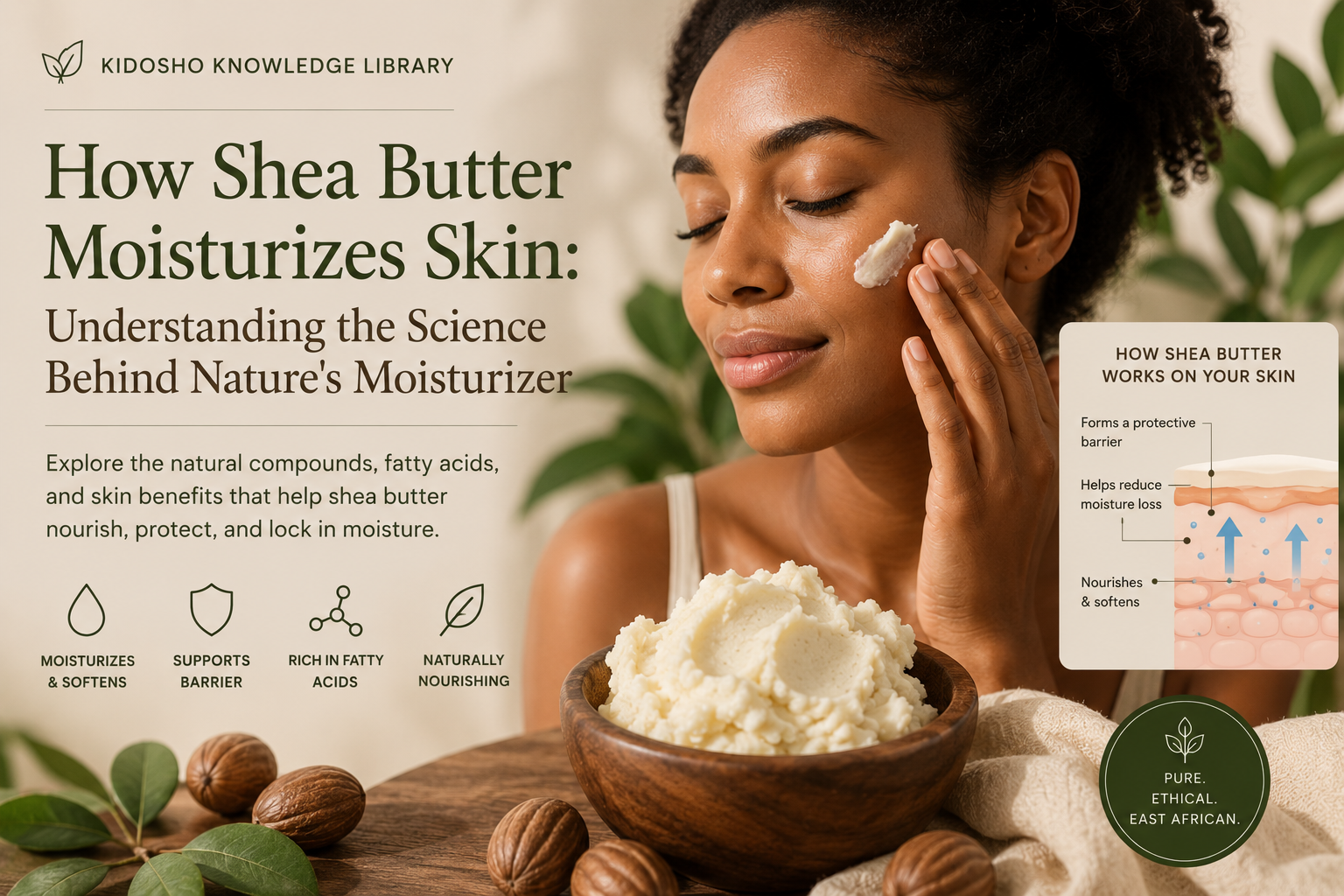
Great Skincare Starts with Understanding Your Skin
Have you ever wondered how Shea Butter actually moisturizes your skin?
Is it adding water?
Does it heal damaged skin?
Or does it work in an entirely different way?
For centuries, Shea Butter has been trusted as a natural moisturizer. Today, advances in dermatology and skin science help us understand why this remarkable botanical ingredient has stood the test of time.
The answer lies not in adding moisture—but in helping your skin hold onto the moisture it already has.
At KIDOSHO, we believe understanding how an ingredient works is just as important as knowing what it is.
In This Article
You’ll learn:
- What skin hydration really means
- Why your skin loses moisture
- How the skin barrier protects you
- How Shea Butter helps reduce moisture loss
- Why Nilotica Shea Butter feels different
- What scientific research tells us
Moisturized Skin Is Not the Same as Wet Skin
Many people assume that moisturizing means adding water to the skin.
That’s only part of the story.
Healthy skin naturally contains water.
The challenge isn’t getting water into your skin—it’s keeping it there.
Every day your skin slowly loses water through a normal process called transepidermal water loss (TEWL).
A healthy skin barrier slows that process.
When the barrier becomes weakened, water escapes more quickly than your skin can replace it.
That’s when skin begins to feel:
- dry
- tight
- rough
- flaky
- uncomfortable
Meet Your Skin Barrier
Your outer layer of skin—called the stratum corneum—acts as your body’s protective shield.
Dermatologists often describe it using the “brick and mortar” analogy.
Imagine a brick wall.
- The skin cells are the bricks.
- The natural lipids surrounding those cells are the mortar.
Together they create a barrier that helps:
- retain moisture
- protect against irritants
- defend against pollutants
- reduce water loss
- support healthy-looking skin
When that barrier becomes damaged, the mortar weakens.
Water escapes more easily.
Shea Butter Supports the Barrier
This is where Shea Butter comes in.
Unlike water-based moisturizers that primarily hydrate the skin temporarily, Shea Butter functions primarily as an emollient and occlusive.
As an Emollient
It softens rough skin by filling tiny spaces between skin cells.
This improves skin texture and leaves it feeling smoother.
As an Occlusive
Shea Butter forms a lightweight protective layer on the skin’s surface.
This layer helps slow the evaporation of water, allowing the skin to remain hydrated for longer.
Rather than forcing moisture into the skin, Shea Butter helps your skin conserve the moisture it already contains.
The Power of Natural Lipids
Pure Nilotica Shea Butter naturally contains:
- Oleic acid
- Stearic acid
- Linoleic acid
- Palmitic acid
These fatty acids resemble some of the lipids naturally found within healthy skin.
When applied topically, they help condition the skin’s surface and contribute to improved softness and flexibility.¹
Why Nilotica Shea Butter Feels Different
As discussed in Article #2: Why Nilotica Shea Butter Is Different, East African Nilotica Shea Butter contains a naturally higher proportion of oleic acid than many West African shea butters.
This contributes to:
- a softer texture
- easier spreading
- faster melting at skin temperature
- an elegant, lightweight feel
Many users find that Nilotica Shea Butter leaves skin feeling moisturized without the heavy residue sometimes associated with richer botanical butters.
More Than Fatty Acids
Shea Butter is more than a source of natural oils.
It also contains an unsaponifiable fraction—a group of naturally occurring plant compounds that remain after soap-making reactions.
These include:
- Tocopherols (Vitamin E)
- Phytosterols
- Triterpenes
These compounds have been studied for their antioxidant and skin-conditioning properties and contribute to the overall value of Shea Butter in cosmetic formulations.²
Water In. Water Out.
Think of your skin like a sponge.
A sponge placed in water becomes saturated.
Leave it exposed to dry air and it gradually loses moisture.
Now imagine wrapping that sponge in a breathable protective cover.
The water evaporates more slowly.
Shea Butter works in a similar way.
It doesn’t “trap” your skin under a heavy seal.
Instead, it creates a breathable protective layer that helps reduce excessive moisture loss while allowing the skin to function naturally.
Why Consistency Matters
One application of Shea Butter can improve skin softness.
Regular application helps maintain the skin barrier over time.
For many people, applying Shea Butter:
- after showering
- before bedtime
- after washing hands
- during cold weather
helps keep skin comfortable throughout the day.
Healthy skin isn’t created overnight.
It develops through consistent care.
What Shea Butter Doesn’t Do
Good skincare education also means understanding what an ingredient doesn’t do.
Pure Shea Butter is not:
- a sunscreen
- a prescription medication
- a cure for eczema
- a cure for psoriasis
- a substitute for medical treatment
Instead, it functions as a natural moisturizer that helps support healthy skin by reducing moisture loss and improving skin comfort.
What the Research Says
Scientific research consistently describes Shea Butter as a naturally lipid-rich botanical ingredient that functions as an effective emollient, helping soften the skin and reinforce its protective barrier.¹
Its naturally occurring fatty acids—including oleic, stearic, linoleic, and palmitic acids—help reduce transepidermal water loss (TEWL), allowing the skin to retain moisture more effectively.³
Researchers also recognize Shea Butter’s unsaponifiable fraction, which contains tocopherols (Vitamin E), phytosterols, and triterpenes. These compounds contribute antioxidant and skin-conditioning properties that make Shea Butter valuable in cosmetic science.²
While these findings support Shea Butter’s role as a moisturizer, current evidence does not support claims that it cures or treats medical skin disorders.
Frequently Asked Questions
Does Shea Butter add moisture to the skin?
Not directly.
Shea Butter primarily helps reduce moisture loss, allowing the skin to retain its natural hydration more effectively.
What is transepidermal water loss?
Transepidermal water loss (TEWL) is the natural evaporation of water through the skin.
Reducing excessive TEWL is one of the primary goals of effective moisturizers.
Why does Shea Butter work so well on dry skin?
Its naturally occurring fatty acids help soften the skin while supporting the skin’s protective barrier.
Is Nilotica Shea Butter different from regular Shea Butter?
Yes.
As discussed in Article #2, Nilotica Shea Butter has a naturally higher oleic acid content, giving it a softer texture and faster absorption.
How often should I use Shea Butter?
Many people apply Shea Butter once or twice daily, particularly after bathing or before bedtime.
Key Takeaways
- Moisturized skin depends on retaining water—not simply adding it.
- Healthy skin barriers reduce transepidermal water loss.
- Shea Butter functions primarily as an emollient and occlusive moisturizer.
- Nilotica Shea Butter contains naturally occurring fatty acids that help condition the skin.
- Consistent use supports long-term skin comfort and hydration.
- KIDOSHO uses only 100% pure Nilotica Shea Butter, allowing nature’s own moisturizing system to shine.
Related Articles
Previously in the KIDOSHO Knowledge Library
← Article #1: What Is Nilotica Shea Butter?
← Article #2: Why Nilotica Shea Butter Is Different
← Article #3: From Tree to Jar: The Journey of Pure Nilotica Shea Butter
← Article #4: Benefits of Shea Butter for Dry Skin
← Article #5: Sensitive Skin Guide: Is Shea Butter Right for You?
Continue Reading
→ Article #7: Can You Use Shea Butter on Your Face?
You may also enjoy:
- Daily Skincare Routine with Shea Butter (coming soon)
- Understanding Vitamins A & E in Shea Butter (coming soon)
- Does Shea Butter Clog Pores? (coming soon)
- Pure Shea Butter: One Ingredient, Many Benefits (coming soon)
References
- Zhang, X., et al. (2026). Shea Butter: A Comprehensive Review of Its Compositions, Processing, Applications, and Challenges. Journal of the American Oil Chemists’ Society.
- ScienceDirect Topics. Shea Butter (Vitellaria paradoxa): Composition, Properties and Applications.
- Elias, P. M. (2005). Stratum Corneum Defensive Functions: An Integrated View. Journal of Investigative Dermatology. This landmark paper explains the role of the skin barrier and transepidermal water loss in maintaining healthy skin.
- Baumann, L. Shea Butter. Dermatology News. Review of the cosmetic properties of Shea Butter, including its role as an emollient and skin-conditioning ingredient.
About KIDOSHO
At KIDOSHO, we believe the best skincare starts with understanding—not marketing myths.
Our products are crafted with 100% pure, ethically sourced Nilotica Shea Butter, chosen for its naturally rich lipid profile, elegant texture, and ability to support the skin’s natural barrier. Through the KIDOSHO Knowledge Library, we combine generations of East African tradition with modern dermatologic science to help you make informed, confident choices about your skin.
Because healthy skin isn’t about chasing trends—it’s about working in harmony with nature.
Natural is the New Beautiful.